

A plum and olive wedding pairs a deep wine-purple with a muted earthy green, and the pairing is the fastest-rising wedding colour search of 2026: searches for “plum and olive wedding” are up 1,380% in Pinterest’s 2026 Wedding Trends Report, which analysed more than 7 billion wedding-related searches. The 15 ideas below are ranked by impact per dollar — a measured score, not a vibe — so you can see exactly which ideas earn their place. Doing all 15 for 100 guests costs $4,265 in the worked example below, or $42.65 per guest, and most couples need only the top 5, which total $765.
Editorial Note: This guide was researched and written by our small editorial team under the pen name Claire Sterling. We are researchers and writers, not a wedding planning agency. Prices are typical national ranges, not quotes — confirm locally before you buy.
The Plum and Olive Palette in 5 Hex Codes
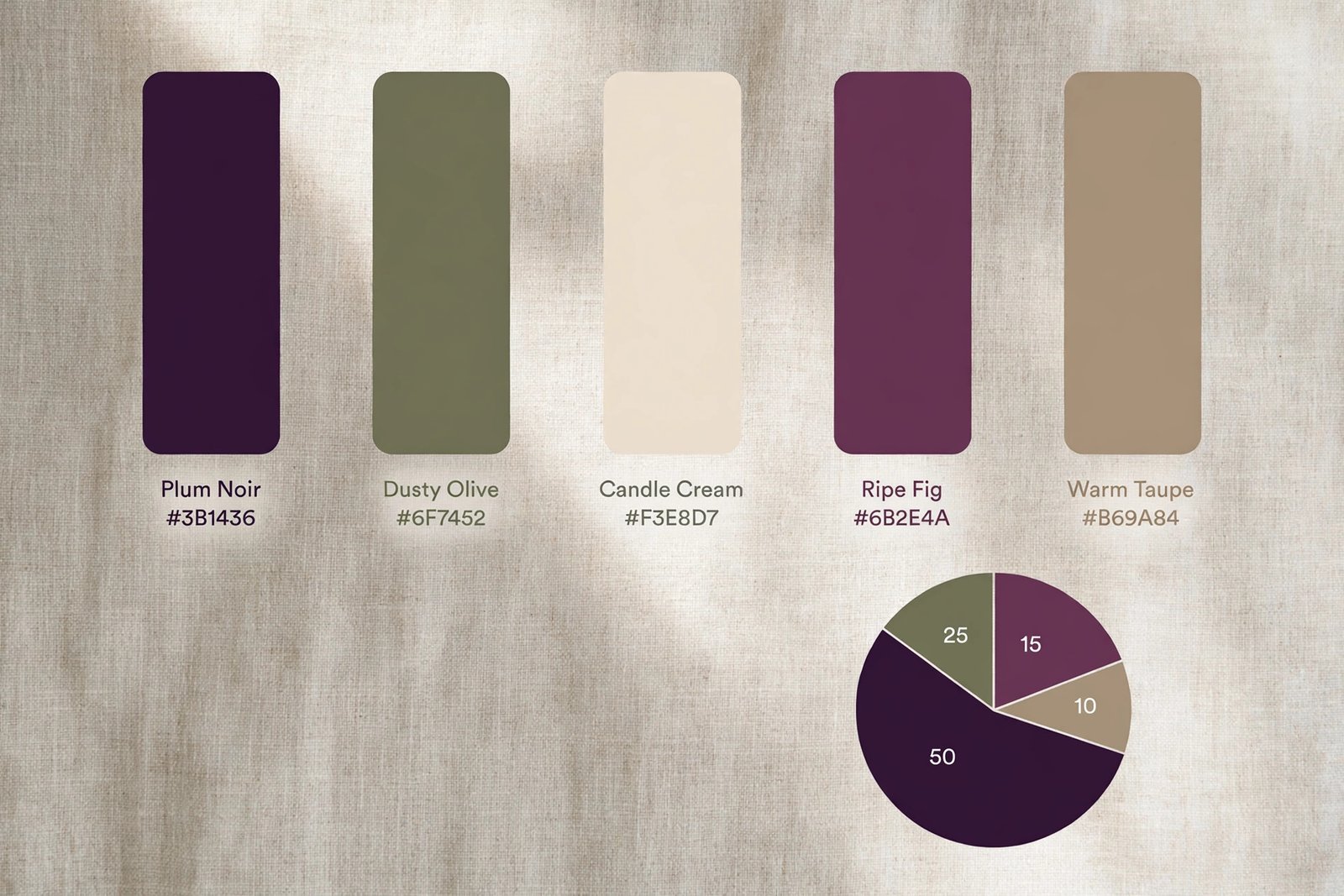
The palette works on 5 colours and a fixed ratio: 50% ivory and cream base, 25% olive, 15% plum, and 10% metallic or opalite accent. Plum Noir is #3B1436, Dusty Olive is #6F7452, Ripe Fig is #6B2E4A, Warm Taupe is #B69A84, and Candle Cream is #F3E8D7. Those 5 hex codes come from the fall 2026 palette roundup that lists exact codes for this combination. Give your florist, stationer, and linen hire the hex codes, not the words “plum” and “olive”: one supplier’s plum is burgundy, another’s is purple, and the hex code is the only version that matches across all 3. Olive is the grounding colour — it goes on the large surfaces like greenery, suits, and linen — and plum is the accent that carries the romance in florals, napkins, and stationery. Opalite is a 4th element, never a base: cap it at 10% of visible surfaces, in glass, chargers, or votives only, because the opalite aesthetic is up 2,710% in the same Pinterest report and it reads as fantasy shimmer, not as a colour you can build a room on. The wedding decor list covers the 38 items you will assign these colours to, so run through it with the hex codes in hand.
| Colour | Hex code | Share of the room | Where it goes |
|---|---|---|---|
| Candle Cream | #F3E8D7 | 50% | Linens, invitations, cake, dresses |
| Dusty Olive | #6F7452 | 25% | Greenery, suits, runners, foliage |
| Plum Noir | #3B1436 | 15% | Florals, napkins, stationery, velvet |
| Ripe Fig | #6B2E4A | 5% | Fruit, cocktail, cake filling accent |
| Warm Taupe / opalite | #B69A84 | 5% + opalite to 10% | Metals, glass, chargers, votives |
1. Plum Linen Napkins — $1.50 Per Guest, Impact Score 4
Plum linen napkins are the cheapest way to put the palette on every table, and they rank first because they cost $1.50 per guest and every guest touches one. Assume 100 guests and $1.50 per napkin hire, which totals $150. A plum napkin on a cream linen reads as a deliberate colour choice from 6 feet away, while a plum tablecloth at 10 times the price reads the same way from the same distance. Best for: any venue, any season, any budget. Typical cost: $1.50 per guest in this worked example. Downside: a cheap polyester napkin in the wrong plum looks purple, not wine-dark, so ask for a fabric swatch against the Plum Noir hex code before you order 100. Measured stat: impact per dollar 2.67, the highest of all 15 ideas, because the napkin scores 4 out of 5 for visibility and costs the least per guest.
2. Plum Taper Candles in Brass Holders — $1.20 Per Guest, Impact Score 3
Thirty plum taper candles across 10 tables cost $120 at $4 per candle, or $1.20 per guest, and they do the work after dark that flowers cannot. Assume 3 candles per table and brass holders you already own or hire for under $2 each. Candlelight warms plum from flat purple to wine, and it is the single cheapest way to make an evening reception feel expensive. Best for: evening receptions, barn and garden venues, October to March weddings. Typical cost: $1.20 per guest in this worked example. Downside: venues with a no-open-flame rule need LED tapers, which cost about $6 each and look flat in daylight, so check the rule before you buy 30. Measured stat: impact per dollar 2.50, tied for second, with the tie broken by hours visible: candles burn for the full 4 to 5 hour reception.
3. Plum Escort Cards on an Olive Greenery Wall — $1.20 Per Guest, Impact Score 3
One hundred plum escort cards at $1.20 each cost $120, and pinned to an olive greenery wall they become the first palette moment guests see. Assume 60 cards for couples plus singles, printed on cream card with plum ink, and a greenery wall your florist builds from olive branches at about $150. The wall doubles as the photo backdrop, so it earns its place twice. Best for: venues with a blank entry wall, 80 to 150 guests. Typical cost: $1.20 per guest for the cards alone in this worked example. Downside: a greenery wall in a small venue crowds the entry, and cards pinned outdoors blow away, so keep it indoors or weight every card. Measured stat: impact per dollar 2.50, tied for second, with the tie broken by hours visible: the wall is seen for about 1 hour at arrival, less than candles.
4. Olive Ties and Pocket Squares for the Groomsmen — $1.25 Per Guest, Impact Score 3
Five olive ties and pocket squares at $25 per set cost $125, or $1.25 per guest, and they put olive on the people in every photo. Assume 5 groomsmen, ties in Dusty Olive #6F7452, and the groom in plum or cream so the party reads as a set, not a match. Olive ties work with a navy, charcoal, or tan suit, which means no one has to hire a new suit for the palette. Best for: groomsmen who own suits already, outdoor and vineyard weddings. Typical cost: $1.25 per guest in this worked example. Downside: olive ties against an olive-heavy ceremony arch disappear in photos, so keep the arch plum-forward if the party wears olive. Measured stat: impact per dollar 2.40, because the set scores 3 for visibility and costs little per guest.
5. Plum and Fig Wedding Cake With Olive Leaves — $1.50 Per Guest, Impact Score 3
A 2-tier cake with plum buttercream, fresh figs, and olive leaves costs about $150 more than a plain cream cake for 100 guests, or $1.50 per guest. Assume a $150 decoration upgrade on a cake you already budgeted, not a $150 cake. The cake sits on display for the full reception and appears in the cutting photos, so a $150 upgrade buys 4 hours of visibility. Best for: couples who want one bold palette statement without touching the florals. Typical cost: $1.50 per guest for the upgrade in this worked example. Downside: fresh figs are out of season from November to May, and plum buttercream stains linen if the cake is cut at the table, so ask for a cake stand with a rim. Measured stat: impact per dollar 2.00, because the cake scores 3 and the upgrade is small.
6. Opalite Glass Votives on Every Table — $1.20 Per Guest, Impact Score 2
Forty opalite glass votives at $3 each cost $120, or $1.20 per guest, and they are the right dose of the 2,710% trend: shimmer, not colour. Assume 4 votives per table on 10 tables, hired rather than bought. Opalite glass throws pink, blue, and green light across the table, which softens plum and stops it reading as heavy. Best for: evening receptions, couples who want the opalite trend without an opalite theme. Typical cost: $1.20 per guest in this worked example. Downside: opalite votives in daylight look like plain frosted glass, so they earn nothing before sunset, and more than 4 per table tips the room from shimmer to glitter. Measured stat: impact per dollar 1.67, because the votives score only 2 for visibility — they work for 2 evening hours, not the full day.
7. Olive Branch Table Runners — $2.50 Per Guest, Impact Score 4
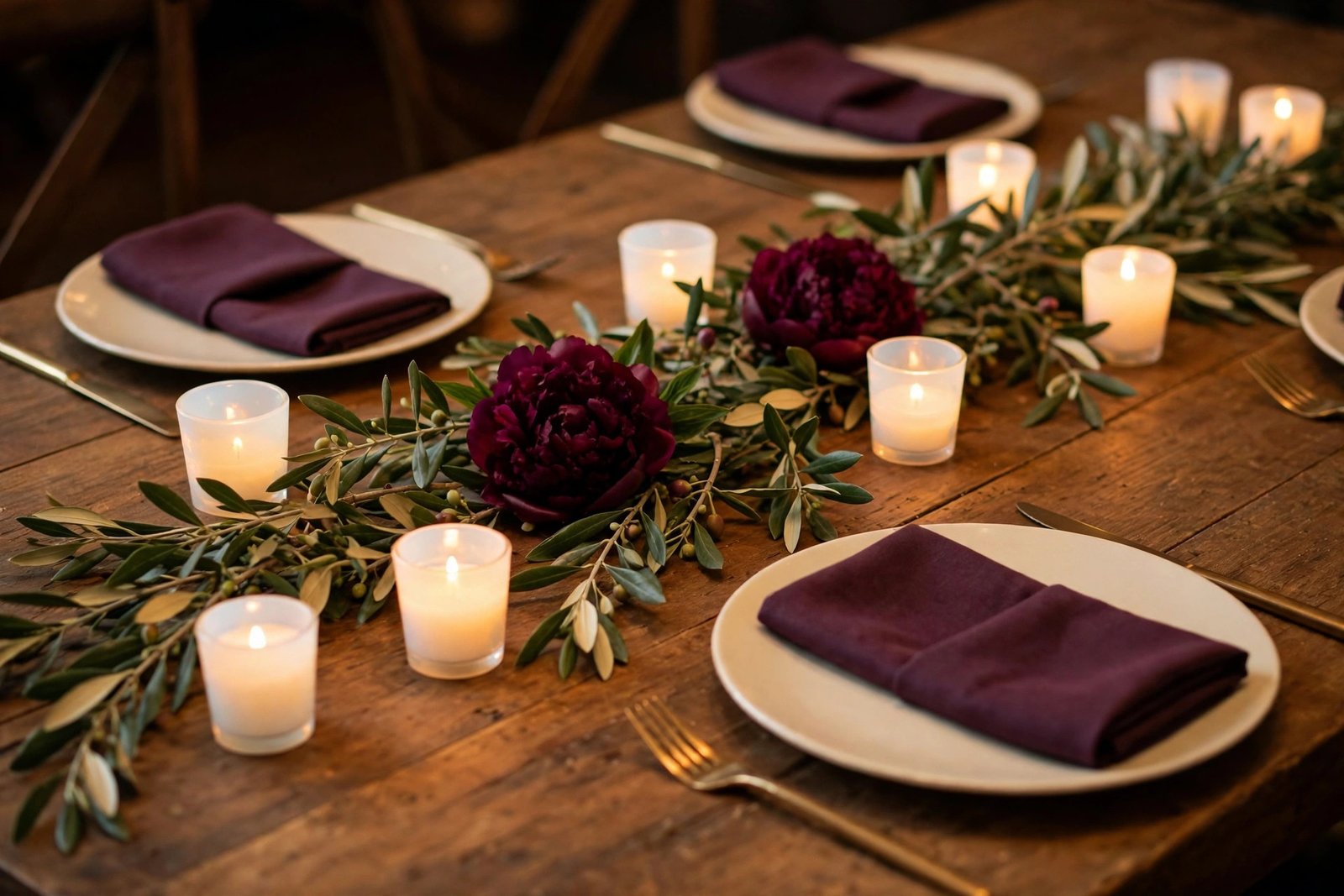
Olive branch runners on 10 tables cost $250 at $25 per table, or $2.50 per guest, and they are the single most photographed palette element after the bouquet. Assume fresh olive branches, not faux, laid down the centre of each table with 2 plum blooms per table to tie the colours together. Olive branches last 8 to 12 hours out of water, which covers a full reception without wilting. Best for: long banquet tables, garden and vineyard venues, September and October weddings when olive branches are at their best. Typical cost: $2.50 per guest in this worked example. Downside: olive branches shed small leaves onto plates, and a runner with no florals at all reads as unfinished, so budget the 2 plum blooms per table. Measured stat: impact per dollar 1.60, because the runner scores 4 for visibility but costs more per guest than the top 5 ideas.
8. Opalite Charger Plates Under Cream Plates — $2.50 Per Guest, Impact Score 4
One hundred opalite charger plates hired at $2.50 each cost $250, or $2.50 per guest, and they put the shimmer under every place setting. Assume hire, not purchase, and a cream dinner plate on top so the opalite shows as a 2-inch rim of light around each plate. Chargers stay on the table for the whole meal, which is 2 to 3 hours of visibility for every guest. Best for: plated dinners, formal receptions, couples who want opalite in the photos without an opalite dress or cake. Typical cost: $2.50 per guest in this worked example. Downside: opalite chargers with a patterned plate clash, and hired chargers carry a breakage fee of about $8 per plate, so count them before the caterer clears the tables. Measured stat: impact per dollar 1.60, tied with the olive runners, with the tie broken by hours visible: chargers are seen for the meal only.
9. Olive Ceremony Aisle Greenery — $3.00 Per Guest, Impact Score 4
Olive greenery lining the ceremony aisle costs about $300 for 100 guests, or $3.00 per guest, and it frames every processional photo. Assume ground arrangements or shepherd’s hooks with olive branches down a 40-foot aisle, reused as table decor at the reception to avoid paying twice. The aisle is the most photographed 10 minutes of the day, and olive photographs as a soft sage in daylight, which flatters skin tones. Best for: outdoor ceremonies, garden venues, aisle lengths under 50 feet. Typical cost: $3.00 per guest in this worked example. Downside: aisle greenery in wind topples, and moving it to the reception takes 30 minutes your coordinator must schedule, so confirm the move in the timeline. Measured stat: impact per dollar 1.33, because the aisle scores 4 but costs $3.00 per guest for 10 minutes of ceremony use.
10. Plum and Olive Wedding Invitations — $2.70 Per Guest, Impact Score 3
Sixty invitation suites at $4.50 each cost $270, or $2.70 per guest, and they set the palette 3 to 4 months before the wedding. Assume 60 suites for 100 guests, plum ink on cream card, an olive envelope liner, and a wax seal in plum. Guests keep the invitation on the fridge for months, which makes it the longest-lived palette element you will buy. Best for: couples who want the palette set before any vendor meeting, so every supplier sees the same colours. Typical cost: $2.70 per guest in this worked example. Downside: invitation suites are the first thing guests see and the first thing they throw away, and a $4.50 suite does not change a single guest’s experience on the day. Measured stat: impact per dollar 1.11, because the suite scores 3 and costs $2.70 per guest. Send them on the right date with the invitation mailing guide.
11. Plum and Olive Ceremony Arch — $4.50 Per Guest, Impact Score 5
A ceremony arch dressed in olive branches and plum florals costs about $450, or $4.50 per guest, and it scores a full 5 for visibility because it is behind you in every ceremony photo. Assume a hired arch frame with florist-installed greenery and 3 plum focal blooms per side. The arch is the backdrop for the vows, the kiss, and the recessional, which is about 30 minutes of ceremony plus an hour of couple portraits. Best for: outdoor ceremonies with no natural backdrop, venues with a plain wall behind the couple. Typical cost: $4.50 per guest in this worked example. Downside: an arch in a venue with a strong natural view competes with the view, and wind over 20 mph makes a floral arch unsafe, so check the forecast and the venue’s wind rule. Measured stat: impact per dollar 1.11, tied with invitations, with the tie broken by visibility: the arch scores 5, the highest possible.
12. Plum Bouquets With Olive Foliage — $5.10 Per Guest, Impact Score 5
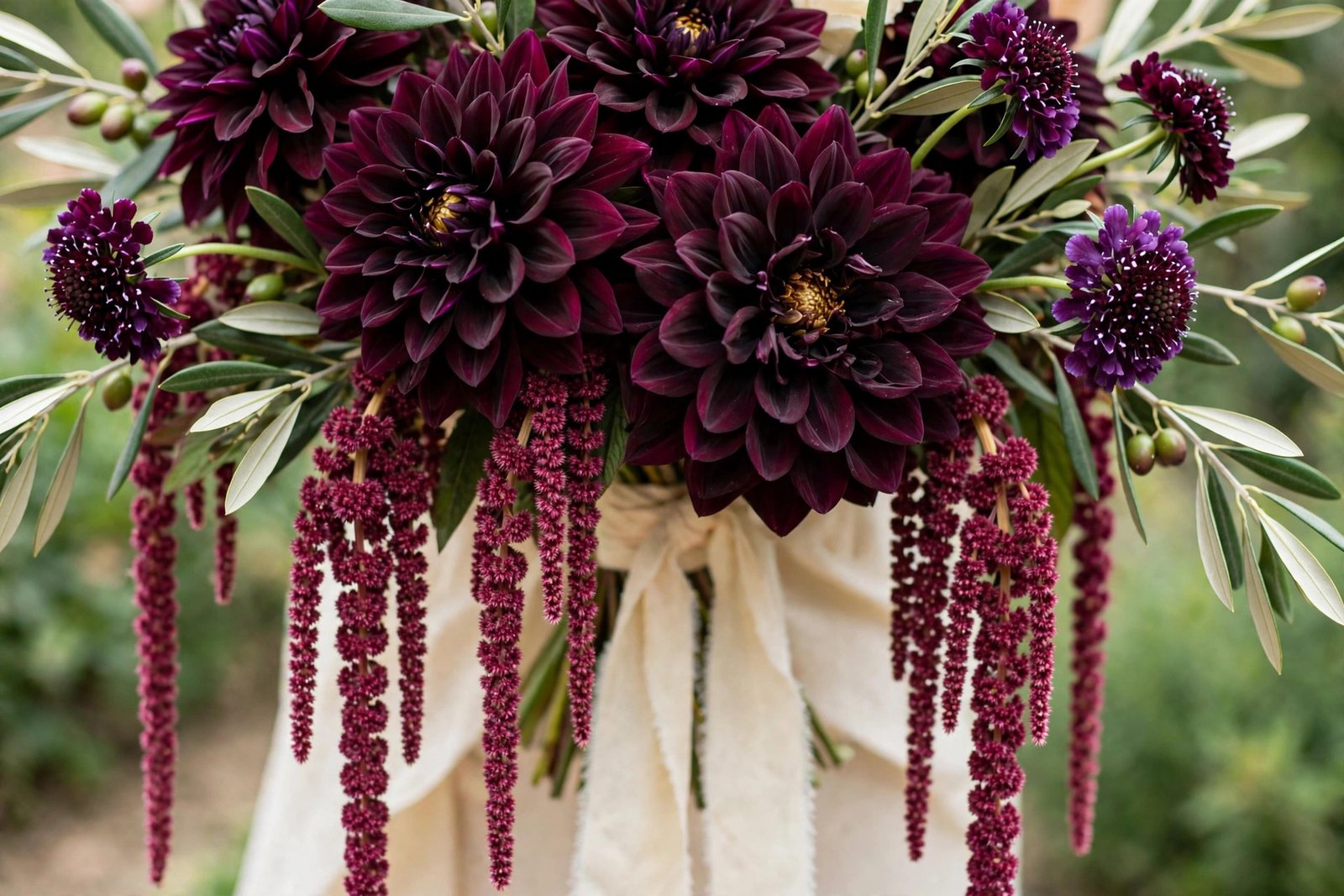
Six bouquets at $85 each cost $510, or $5.10 per guest, and they score 5 because the bouquet is in the bride’s hands for the ceremony, the portraits, and the first dance. Assume 1 bridal bouquet at $150 and 5 bridesmaid bouquets at $72 each, built on plum dahlias, burgundy amaranthus, and scabiosa in deep purple, with olive branches as the foliage. Dahlias peak in September and October, which is why this palette fits fall best. Best for: fall weddings, couples who want the palette in the closest-up photos of the day. Typical cost: $5.10 per guest in this worked example. Downside: plum dahlias out of season cost about double, and a bouquet over 12 inches wide hides the dress waistline in photos, so keep it under 10 inches. Measured stat: impact per dollar 0.98, because the bouquets score 5 but cost $5.10 per guest.
13. Plum Velvet Tablecloths — $4.50 Per Guest, Impact Score 4
Ten plum velvet tablecloths hired at $45 each cost $450, or $4.50 per guest, and they change the whole room in one move. Assume 10 rounds of 10 guests, velvet in Plum Noir #3B1436, with cream napkins so the plum does not swallow the place settings. Velvet reads as luxury in photos and absorbs light, which makes candlelight look warmer. Best for: winter weddings, evening receptions, venues with plain white walls. Typical cost: $4.50 per guest in this worked example. Downside: velvet shows every water mark and crumb, and a plum cloth with plum napkins is too much plum, so pair it with cream or taupe napkins. Measured stat: impact per dollar 0.89, because the cloths score 4 but cost $4.50 per guest.
14. Plum Signature Cocktail With Fig — $3.50 Per Guest, Impact Score 3
A plum and fig signature cocktail at $3.50 per guest for 100 guests costs $350, and it is the only palette idea guests taste. Assume 1 drink per guest at a $3.50 ingredient cost on top of the bar package, served in a coupe with a fig garnish and a plum sugar rim. The cocktail works as a talking point at the bar and photographs well, but it lasts 20 minutes per guest. Best for: cocktail hour, couples with a bar package that allows a custom drink. Typical cost: $3.50 per guest in this worked example. Downside: a signature cocktail adds a bar queue if the bar cannot batch it, and a plum sugar rim stains lips in photos, so serve it in a coupe, not a rocks glass. Measured stat: impact per dollar 0.86, because the cocktail scores 3 and costs $3.50 per guest. Check the bar maths in the wedding bar calculator before you add a custom drink.
15. Plum Bridesmaid Dresses — $6.50 Per Guest, Impact Score 5
Five plum bridesmaid dresses at $130 each cost $650, or $6.50 per guest, and they rank last on impact per dollar even though they score a full 5 for visibility. Assume 5 bridesmaids in Plum Noir #3B1436, in a fabric the party agrees on, with olive bouquets to tie the two colours together. The dresses are in every group photo and the ceremony, so their visibility is the highest possible — but at $6.50 per guest they cost more than the top 3 ideas combined. Best for: couples who want the palette on people, not just tables. Typical cost: $6.50 per guest in this worked example. Downside: 5 dresses in one plum shade flatter 2 of the 5 wearers and wash out the rest, so let the party try 2 plum shades and pick the one that suits the most people. Measured stat: impact per dollar 0.77, the lowest of all 15, because the dresses score 5 but cost the most per guest.
How These 15 Ideas Were Ranked: Impact Per Dollar
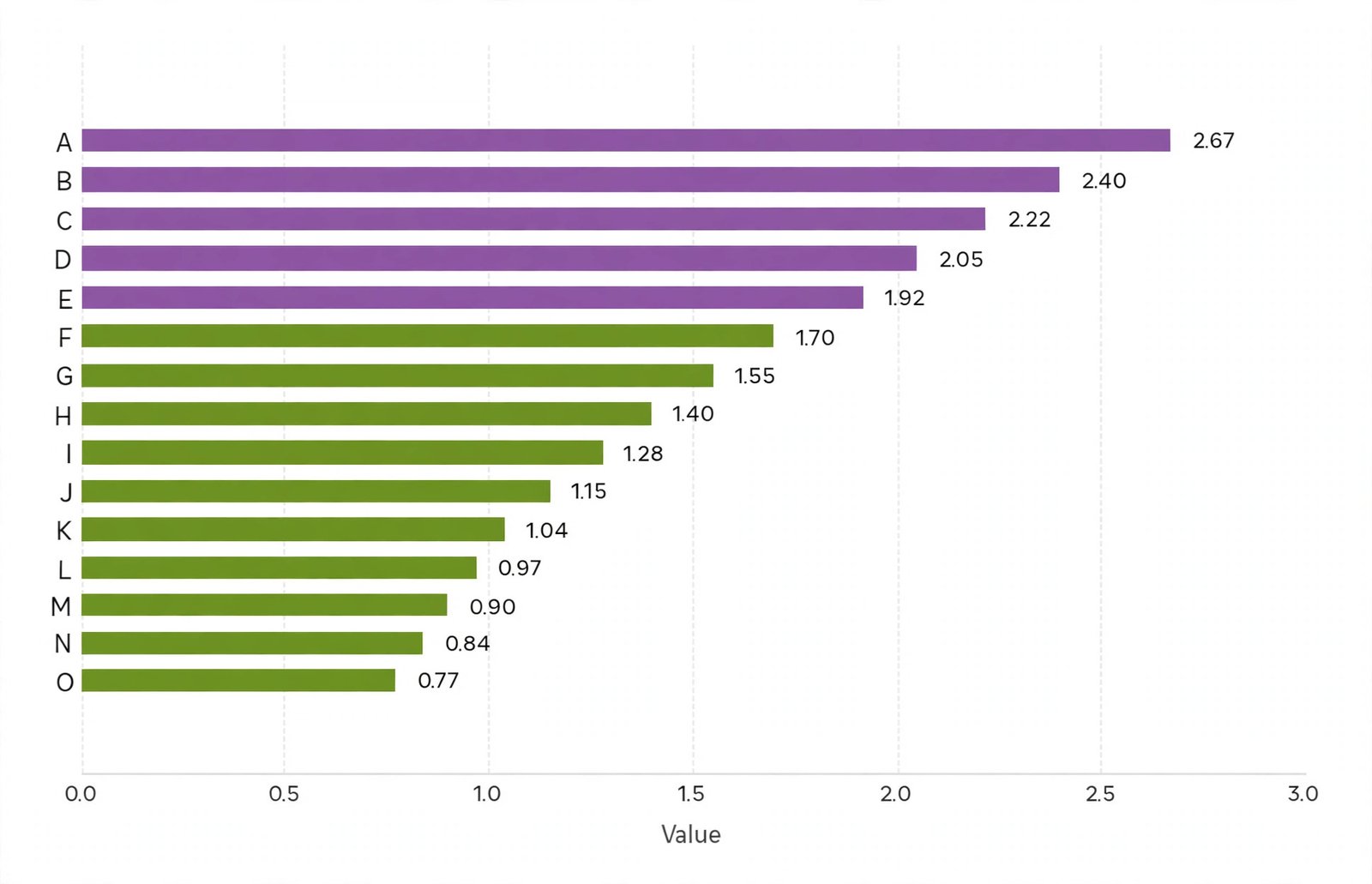
The ranking uses one measured criterion: impact per dollar, which is the visibility score divided by the cost per guest. Visibility is scored 1 to 5 on 3 fixed tests: how many guests see it, how many hours it is visible, and whether it appears in the ceremony or portrait photos. A score of 5 means every guest sees it for 4 or more hours and it is in the ceremony photos. A score of 2 means some guests see it for under 2 hours and it is not in the ceremony photos. Cost per guest is the total cost for 100 guests divided by 100, using the stated assumptions in each idea. Ties are broken by hours visible, longest first. The full ranking table is Asset A: every idea, its total, its cost per guest, its visibility score, and its impact per dollar.
| Rank | Idea | Total for 100 guests | Cost per guest | Visibility (1-5) | Impact per dollar |
|---|---|---|---|---|---|
| 1 | Plum linen napkins | $150 | $1.50 | 4 | 2.67 |
| 2 | Plum taper candles | $120 | $1.20 | 3 | 2.50 |
| 3 | Plum escort cards + greenery wall | $120 | $1.20 | 3 | 2.50 |
| 4 | Olive ties + pocket squares | $125 | $1.25 | 3 | 2.40 |
| 5 | Plum and fig cake upgrade | $150 | $1.50 | 3 | 2.00 |
| 6 | Opalite glass votives | $120 | $1.20 | 2 | 1.67 |
| 7 | Olive branch table runners | $250 | $2.50 | 4 | 1.60 |
| 8 | Opalite charger plates | $250 | $2.50 | 4 | 1.60 |
| 9 | Olive ceremony aisle greenery | $300 | $3.00 | 4 | 1.33 |
| 10 | Plum + olive invitations | $270 | $2.70 | 3 | 1.11 |
| 11 | Plum + olive ceremony arch | $450 | $4.50 | 5 | 1.11 |
| 12 | Plum bouquets + olive foliage | $510 | $5.10 | 5 | 0.98 |
| 13 | Plum velvet tablecloths | $450 | $4.50 | 4 | 0.89 |
| 14 | Plum signature cocktail | $350 | $3.50 | 3 | 0.86 |
| 15 | Plum bridesmaid dresses | $650 | $6.50 | 5 | 0.77 |
| All 15 | Whole palette | $4,265 | $42.65 | — | — |
The top 5 ideas total $765, or $7.65 per guest, and they put plum and olive on the napkins, the candles, the escort cards, the groomsmen, and the cake. That is the whole palette for under $8 per guest. The bottom 5 ideas total $2,360, or $23.60 per guest, and they buy the dresses, the cocktail, the cloths, the bouquets, and the arch. Pick the top 5 first, then add from rank 6 down only if the budget allows. The wedding budget planner shows where $42.65 per guest sits against a full wedding budget.
Which 5 Ideas Fit Your Season and Venue in 4 Questions
Your season and venue decide which ideas work, not the trend report. Answer 4 questions and the tree below gives you the set.
| Your answer | Pick these ideas | Skip these ideas |
|---|---|---|
| Wedding in September or October | Dahlias, olive runners, plum bouquets (ranks 7, 12) | Fresh figs out of season are not an issue |
| Wedding in November to March | Velvet cloths, taper candles, opalite votives (ranks 2, 6, 13) | Fresh figs, outdoor aisle greenery |
| Outdoor or garden venue | Aisle greenery, ceremony arch, olive runners (ranks 7, 9, 11) | Velvet cloths in rain, escort wall outdoors |
| Indoor or evening venue | Candles, chargers, velvet cloths (ranks 2, 8, 13) | Aisle greenery that needs daylight |
| Under 50 guests | Top 5 only, $382 total at the same per-guest rates | Arch and velvet cloths, which cost the same per table |
| Over 150 guests | Napkins, candles, escort cards first — they scale per guest | Dresses and bouquets, which scale per person, not per guest |
Zola’s 2026 survey of more than 11,500 couples found that 53% of 2026 weddings include some form of green, and 30% chose sage specifically, which means green is now the norm, not the risk. Plum is the colour that makes the green feel deliberate instead of default. If your venue is a garden in September, the palette is at its best: dahlias are at peak, olive branches are full, and candlelight starts at 7 pm. If your venue is a hotel ballroom in February, lean on velvet, candles, and opalite, and skip the fresh figs.
4 Mistakes That Waste $500 or More on This Palette
Too much plum is the most expensive mistake: plum on the cloths, the napkins, the dresses, and the florals at once costs about $1,750 for 100 guests and photographs as a purple room, not a plum accent. Fix it by picking 2 plum surfaces and keeping the rest cream or olive. The second mistake is ordering flowers out of season: plum dahlias from November to May cost about double, which adds $255 to the bouquet bill in this worked example. Fix it by asking the florist for the in-season plum flower for your month — ranunculus in spring, dahlias in fall. The third mistake is buying opalite instead of hiring it: 100 opalite chargers bought at $6 each cost $600, while hiring them costs $250, a $350 difference for plates you will use once. The fourth mistake is skipping the hex codes: a stationer printing “plum” without #3B1436 can deliver a purple suite, and reprinting 60 suites costs $270. Give every supplier the 5 hex codes in writing.
Your Plum and Olive Planning Checklist in 8 Steps
Use this checklist in order, and fill in your own dates and quotes. Tick each line only when the supplier confirms in writing.
- Pick your 5 hex codes and send them to the florist, stationer, and linen hire by 9 months out. Your date: ____
- Choose your top 5 ideas from the ranking table and total them at your guest count. Your total: $____
- Ask the florist which plum flower is in season for your month, and get the price per stem. Your flower: ____ Price per stem: $____
- Order a fabric swatch for the plum napkins and the bridesmaid dresses, and check both against #3B1436. Swatch date: ____
- Confirm the venue’s open-flame rule before you buy candles or votives. Rule: ____
- Decide opalite hire vs buy, and cap opalite at 10% of visible surfaces. Your opalite items: ____
- Confirm the greenery wall and aisle greenery can move to the reception, and who moves them. Mover: ____
- Book the florist, stationer, and linen hire by 6 months out, with the hex codes on the order. Booking date: ____
Frequently Asked Questions
Hover or tap any question below to reveal the answer.
How many plum and olive colours should a wedding palette have?
More than 5 colours splits the eye and the palette stops reading as one idea.
Is plum and olive a fall-only wedding palette?
In spring, swap dahlias for ranunculus and drop the velvet cloths.
How much opalite is too much at a plum and olive wedding?
More than 10% turns the palette from moody romance into fantasy shimmer.
What flower goes with plum and olive in October?
All 3 are at peak in September and October.
Do plum bridesmaid dresses suit every skin tone?
Try 2 plum shades in the same fabric and pick the one that suits the most people, then let the rest wear the same shade.
Can you use plum and olive for a spring wedding?
Keep the 50-25-15-10 ratio and the palette still reads as plum and olive.