

A rehearsal dinner costs $2,800 on average for couples married in 2025, according to The Knot’s 2026 Real Weddings Study of 10,474 couples. That figure is the national average, not a price for your city: a 30-guest dinner runs $1,650 to $4,500 depending on the venue, and the guest count sets the bill more than any other choice. This guide gives you the who-pays rules, the exact guest list, the cost per guest at 3 tiers, and a 6-month plan with deadlines. Start the money conversation 6 months out, book the venue 4 months out, and keep the dinner under 2 hours the night before the wedding.
Editorial Note: This guide was researched and written by our small editorial team under the pen name Claire Sterling. We are researchers and writers, not a wedding planning agency. Prices are typical national ranges, not quotes — confirm locally before you buy.
Who Pays for the Rehearsal Dinner: 4 Ways to Split a $2,800 Bill
The host pays, and tradition hands that job to the groom’s parents. That is still the most common arrangement, but it is no longer the default: couples now split the bill in 4 common ways, and the right one depends on who wants control, not on tradition. First, the groom’s parents host and pay for everything, which is the traditional route and still fits when they offered to host. Second, the couple pays for it themselves, which is the most common choice for couples who are financially independent or who want full control of the guest list and venue. Third, both families split the bill evenly, which works when both sides want to contribute and neither wants to host alone. Fourth, one side hosts the dinner and the other side covers a defined extra, such as the bar or the welcome drinks for out-of-town guests. Pick the split 6 months out, before anyone books a venue, because the host chooses the venue and the guest list, and a host who learns the budget late cannot plan. Whoever pays also decides: if you want total control over the rehearsal dinner, pay for it yourself. If a parent pays, they pick the venue within the budget you agree together. Put the agreement in writing in one message: who pays, the total budget, and who picks the venue. That message prevents the most common rehearsal dinner argument, which is a parent booking a $4,000 restaurant when the couple budgeted $2,000.
| Who pays | Who decides the venue | Best when | Watch out for |
|---|---|---|---|
| Groom’s parents | Groom’s parents | They offered and can afford it | Couple loses control of the guest list |
| The couple | The couple | You want full control | Parents may feel left out |
| Both families split 50-50 | Both families together | Both sides want to contribute | 2 decision makers slow every choice |
| One side hosts, other covers the bar | Host picks venue, other picks drinks | One side has a venue in mind | Bar tab can exceed the dinner bill |
Who Comes to the Rehearsal Dinner: 30 Guests in 3 Tiers
The core guest list is 30 people for a typical wedding, and it has 3 tiers: must-invite, should-invite, and optional. Tier 1, must-invite, is everyone at the ceremony rehearsal: the couple, the wedding party and their partners, both sets of parents, and the officiant plus a partner. That is usually 18 to 22 people. Tier 2, should-invite, is immediate family not in the wedding party: siblings, grandparents, and the parents of flower girls and ring bearers. That adds 4 to 8 people. Tier 3, optional and host-decided, is out-of-town guests, plus-ones of the wedding party beyond Tier 1, and close family friends. Tier 3 is where the list grows from 30 to 60, and where the budget doubles. The rule is simple: everyone who attends the rehearsal gets invited to the dinner, and no guest ever pays for their own meal. If the list passes 40, split the event: a family-only rehearsal dinner for 30, then a casual welcome drink for all out-of-town guests. That split keeps the dinner intimate and the welcome open, and it costs less than inviting 60 people to a seated dinner. For a destination wedding, the rehearsal dinner often includes all out-of-town guests by default, which is why destination dinners average $3,838 against $2,442 for hometown dinners in the Knot’s 2024 research. See the destination wedding planning guide if your rehearsal dinner is part of a destination weekend.
| Tier | Who | Typical count | Rule |
|---|---|---|---|
| 1 Must-invite | Couple, wedding party + partners, both parents, officiant + partner | 18 to 22 | Everyone at the rehearsal eats |
| 2 Should-invite | Siblings, grandparents, flower girl and ring bearer parents | 4 to 8 | Invite unless the budget forbids it |
| 3 Optional | Out-of-town guests, extra plus-ones, close family friends | 0 to 30 | Host decides; split into a welcome drink if over 40 total |
What a Rehearsal Dinner Costs: $55 to $150 Per Guest in 2026
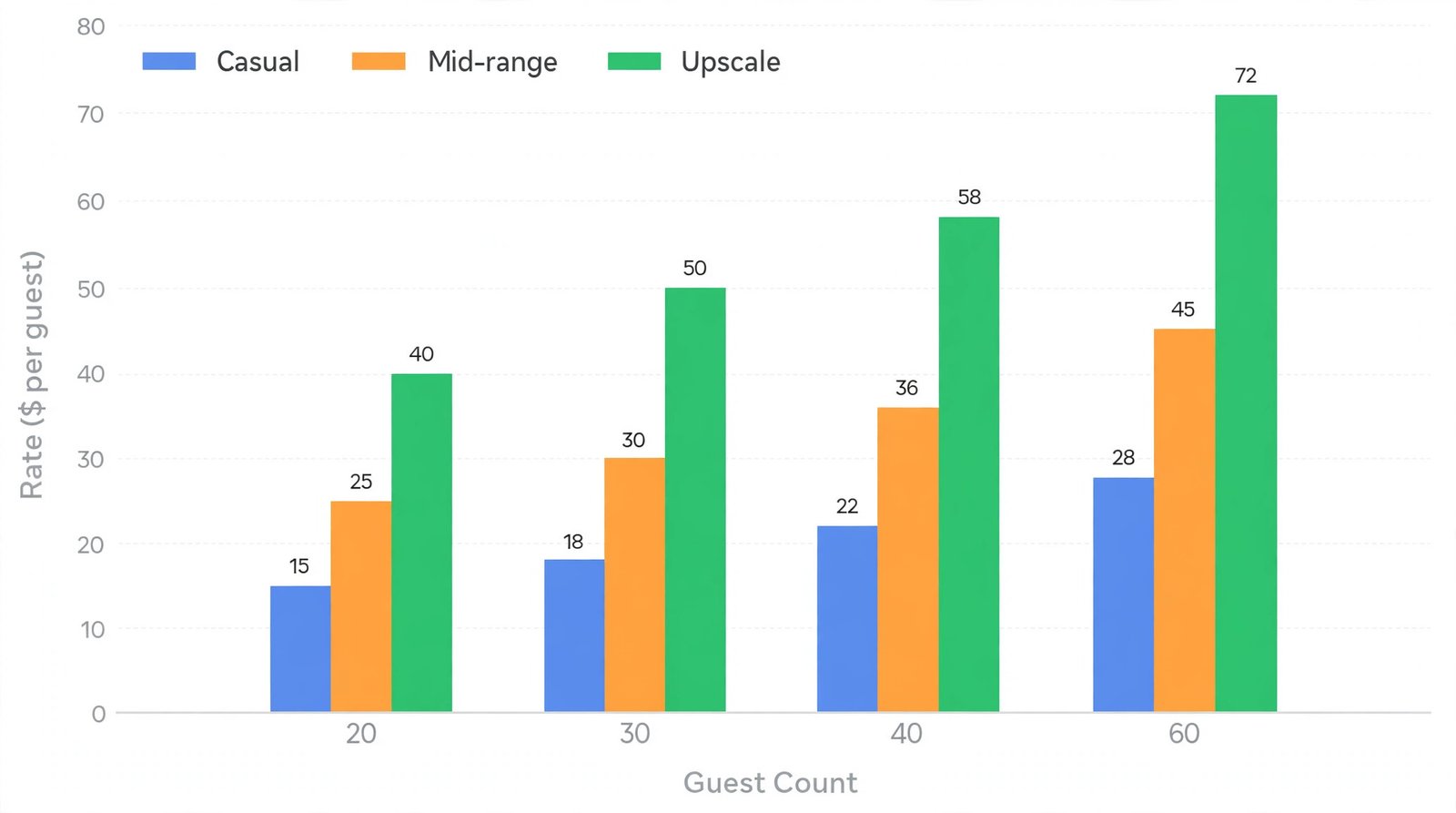
A rehearsal dinner costs $55 to $150 per person for food and drink at most venues, and the national average of $2,800 covers a 30-guest dinner at about $93 per person before tax and service. The $2,800 figure is the average for couples married in 2025, from The Knot’s 2026 study of 10,474 couples. The previous figure, $2,700, covers couples married in 2024, from a study of 16,956 couples, and it was flat from 2023 to 2024 after $2,400 in 2022 and $2,300 in 2021. Treat the average as a planning anchor, not a quote: your city, your guest count, and your venue type move the number more than the national average does. The table below is Asset A. It is computed, not quoted: each cell is the guest count times the per-person rate, and the final column adds 8% tax and 20% service, which are the midpoints of the 6 to 10% tax and 18 to 22% service ranges in Zola’s cost guide. Assume those rates for your own maths, and replace them with your venue’s actual rates when you get the quote.
| Guests | Casual $40 per person | Mid-range $85 per person | Upscale $130 per person | Mid-range with 8% tax + 20% service |
|---|---|---|---|---|
| 20 | $800 | $1,700 | $2,600 | $2,176 |
| 30 | $1,200 | $2,550 | $3,900 | $3,264 |
| 40 | $1,600 | $3,400 | $5,200 | $4,352 |
| 60 | $2,400 | $5,100 | $7,800 | $6,528 |
A 30-guest dinner at the mid-range rate is $2,550 for food and drink, and $3,264 once 8% tax and 20% service are added — a $714 difference that catches couples who budget from the menu price alone. A 20-guest dinner at the casual rate is $800 before fees, which is why a backyard dinner is the cheapest real option. A 60-guest dinner at the upscale rate is $7,800 before fees, which is why the guest list, not the menu, is the budget lever. Every extra guest at the mid-range rate adds $85 before fees and $109 after tax and service. Cut 10 guests and you save $1,090. That is the single most useful number in this guide.
Step 1: Lock the Guest List and the Host 6 Months Out
Step 1 takes 2 hours and 2 decisions: who is invited and who pays. Sit down with both families 6 months before the wedding and agree the Tier 1 and Tier 2 list first, then decide Tier 3. Count the list out loud: 2 for the couple, 8 to 12 for the wedding party and partners, 4 for the parents, 2 for the officiant and partner, and 4 to 8 for Tier 2. That is 20 to 28 people before Tier 3. Then agree the host and the total budget in the same conversation, and write it down in one message. Success looks like a list with names, not a number, and a budget with a dollar figure, not a range. Time: 2 hours for the conversation and 30 minutes to write the list. If the 2 families disagree on Tier 3, the host decides, and the couple can add a welcome drink for the people left out.
Step 2: Book the Venue 4 Months Out
Step 2 takes 3 hours of research and 1 venue visit. Book the venue 4 months before the wedding, because private dining rooms for 30 people book out 3 to 4 months ahead in most cities. Shortlist 3 venues: a restaurant private room at $55 to $120 per person, a brewery or winery taproom, and a backyard or home option. Ask each venue 5 questions: the food and drink minimum, the room fee, the tax and service rates, the latest end time, and the cancellation terms. The food and drink minimum is the number that matters most: a $2,000 minimum for 20 guests is $100 per person even if the menu says $60. Success looks like a signed agreement with the minimum, the rates, and the end time in writing. Time: 3 hours to research and call, 1 hour to visit, 30 minutes to sign. If the venue you want is booked, ask for a weekday or a lunch slot, which often cuts the minimum by 30 to 50%.
Step 3: Set the Menu, Bar, and Toasts 6 Weeks Out
Step 3 takes 2 hours and covers the menu, the bar, and the running order. Pick a menu 6 weeks out: family-style or a 3-course plated dinner, 2 to 3 drinks per person, and a cake or dessert if the venue does not include one. Set the bar as beer and wine plus 1 signature drink, not a full open bar, because a full bar for 30 guests adds $600 to $900 to the bill. Plan 3 to 5 toasts of 2 to 3 minutes each, and assign them now: the host first, then the couple’s parents, then the best man or maid of honor. Give each speaker a 3-minute limit in writing. Success looks like a menu with prices, a bar with a per-person cap, and a toast list with names and order. Time: 1 hour for the menu, 30 minutes for the bar, 30 minutes to confirm the toasts. If a guest has a dietary need, tell the venue now, not on the night.
Step 4: Run the Rehearsal and the Dinner in 4 Hours
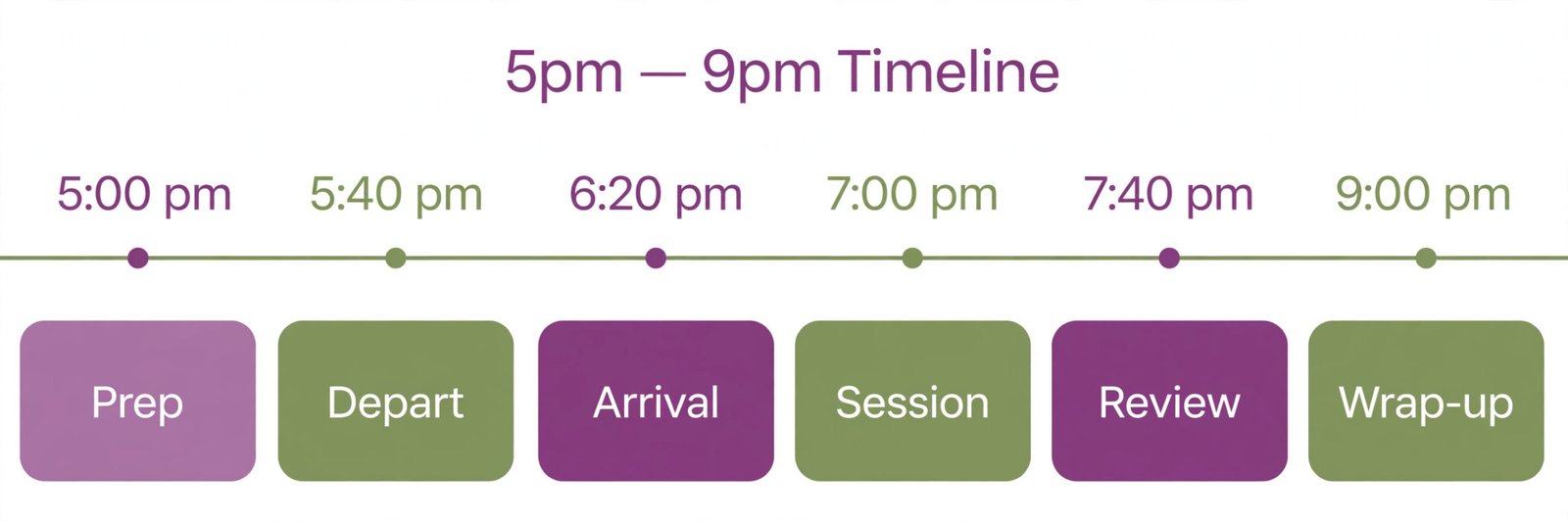
Step 4 is the night itself, and it runs 4 hours from rehearsal to last toast. The ceremony rehearsal takes 45 to 60 minutes at the venue, usually starting at 5 pm. Allow 30 minutes to travel to the dinner venue, then seat everyone by 6:30 pm. Dinner runs 90 minutes: welcome toast at 6:45, mains at 7:15, toasts at 8:00, and the last toast by 8:30. End by 9 pm, because the wedding party needs sleep and the couple needs a clear head. Success looks like a printed running order in the host’s pocket and a venue that knows the end time. Time on the night: 4 hours, plus 1 hour the week before to confirm the venue, the caterer, and the speakers. If the rehearsal runs long, cut a toast, not the dinner: the dinner is the point, and a 10-minute rehearsal overrun is normal. The wedding day timeline template shows how the rehearsal night fits into the full wedding weekend.
3 Costs That Catch Couples Out: $400 to $900 in Fees
Three fees add $400 to $900 to a 30-guest dinner, and none of them is on the menu. First, tax and service: 8% tax and 20% service on a $2,550 food and drink bill is $714, and venues quote the menu price without them. Second, the room fee: a private dining room fee of $200 to $500, which some venues waive if you meet the food and drink minimum and some charge on top of it. Third, overtime and extras: $150 to $300 per hour past the agreed end time, plus $8 per broken charger or glass, plus a cake-cutting fee of $2 to $5 per person if you bring your own cake. Ask for an itemised quote that lists the menu price, the tax rate, the service rate, the room fee, and the overtime rate on one page. If a venue will not itemise, that is a red flag, and the wedding vendor checklist covers the contract questions to ask before you sign. Budget 30% on top of the menu price for fees: a $2,550 menu is a $3,264 bill, and a $1,200 menu is a $1,536 bill.
| Fee | Typical range for 30 guests | How to avoid the surprise |
|---|---|---|
| Tax 8% + service 20% | $714 on a $2,550 menu | Ask for the rates in writing before you book |
| Private room fee | $200 to $500 | Ask if the minimum waives it |
| Overtime past end time | $150 to $300 per hour | Put the end time in the agreement |
| Cake-cutting fee | $2 to $5 per person | Ask before you order the cake |
| Breakage | $8 per plate or glass | Count hire items before the caterer clears |
2 Worked Budgets: $1,910 Backyard and $3,924 Restaurant for 30 Guests
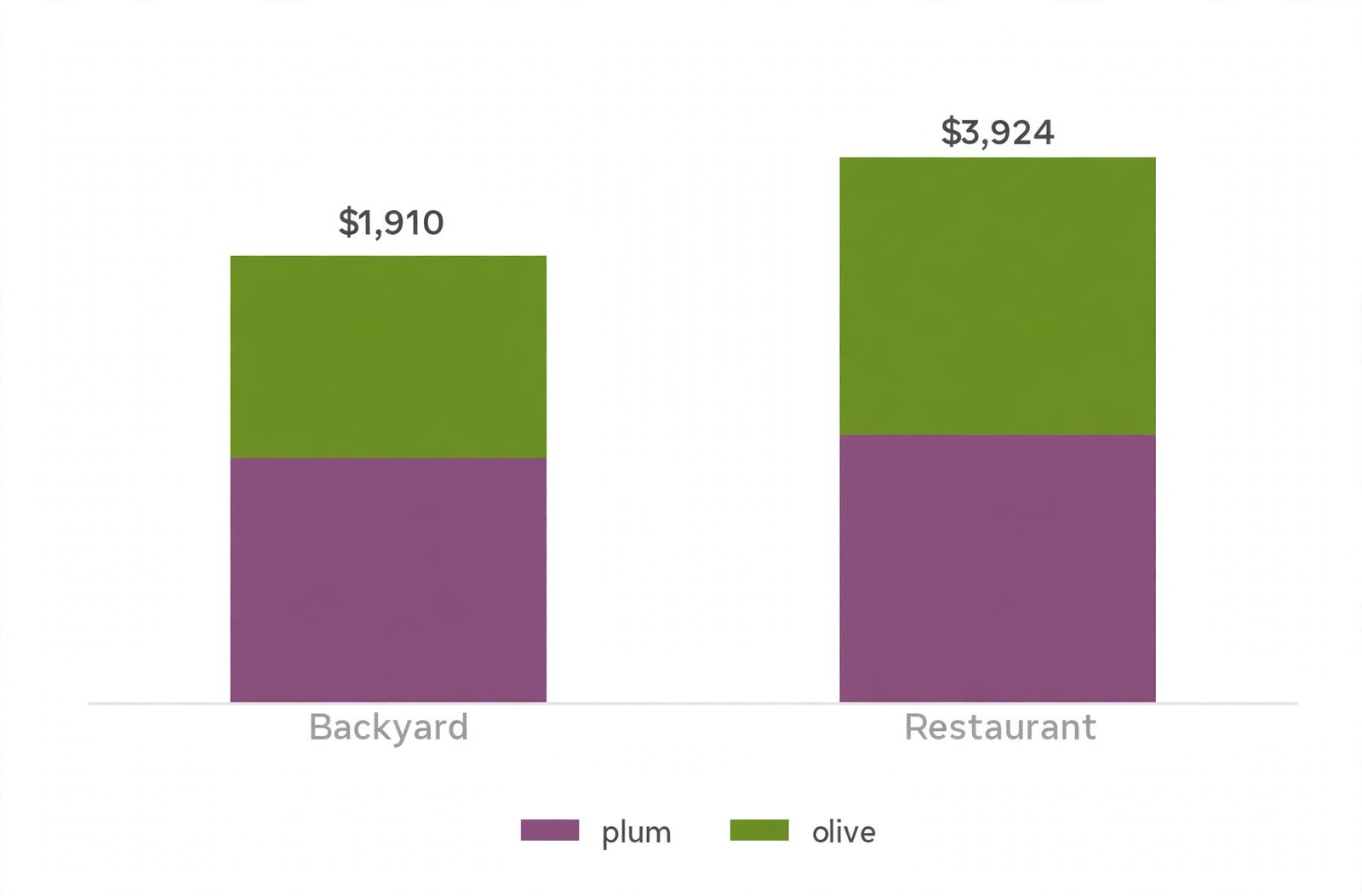
Two worked budgets show where the money actually goes for 30 guests. Both use stated assumptions, not market prices, so you can redo the maths for your own numbers. The backyard budget assumes 30 guests, food at $35 per person, drinks at $12 per person, and rented tables and chairs. The restaurant budget assumes 30 guests, food and drink at $85 per person, 8% tax, 20% service, a $300 room fee, and $150 for decor and $150 for wedding party gifts. The backyard total is $1,910. The restaurant total is $3,924. The $2,014 gap is the venue, the service, and the room fee — not better food.
| Line item | Backyard, 30 guests | Restaurant, 30 guests |
|---|---|---|
| Food | $1,050 at $35 per person | $2,550 at $85 per person |
| Drinks | $360 at $12 per person | Included in the $85 rate |
| Tax at 8% | $0, no venue tax | $204 |
| Service at 20% | $0, self-serve | $510 |
| Room fee | $0 | $300 |
| Rentals (tables, chairs, linen) | $400 | $0, venue provides |
| Decor | $100 | $150 |
| Invitations | $0, message the group | $60 |
| Wedding party gifts | $0, give them at the wedding | $150 for 6 gifts at $25 |
| Total | $1,910 | $3,924 |
| Per guest | $64 | $131 |
The restaurant budget at $3,924 is $1,124 above the $2,800 national average, because the average includes backyard and casual dinners as well as restaurant ones. If your budget is $2,800, the restaurant menu rate you can afford is about $65 per person after tax, service, and a $300 room fee: $2,800 minus $300 room fee is $2,500, divided by 1.28 for tax and service is $1,953, divided by 30 guests is $65 per person. Use that formula with your own numbers before you fall in love with a venue.
What Happens If You Skip the Rehearsal Dinner: 3 Risks
Skipping the rehearsal dinner saves $1,910 to $3,924, but it costs you 3 things. First, the wedding party walks into the ceremony without a practice run, and a 10-minute ceremony delay costs the photographer about $50 in overtime and the venue about $150 in overtime if the schedule slips. Second, the 2 families meet for the first time at the ceremony, which adds stress to a morning that is already tight. Third, out-of-town guests arrive with no plan for the night before, and the couple spends the evening answering messages instead of resting. The fix costs less than the dinner: a 45-minute rehearsal with no dinner, then a casual welcome drink at a bar where guests buy their own drinks. That costs the couple $0 to $200 for a first round, and it keeps the practice and the introductions. If you skip the dinner entirely, still hold the rehearsal: 74% of couples married in 2024 hosted a rehearsal dinner, which means the rehearsal itself is the norm, and the dinner is the part you can shrink.
Time Budget: 12 Hours DIY vs 4 Hours With a Planner
Planning a rehearsal dinner takes 12 hours if you do it yourself, and 4 hours if a planner or the host does it. The DIY hours are: 2 hours for the guest list and host conversation, 3 hours for venue research and calls, 1 hour for the venue visit, 2 hours for the menu, bar, and toasts, 1 hour for confirmations the week before, and 3 hours on the night itself. The planner version is: 1 hour to brief the planner, 1 hour to approve the venue and menu, 1 hour to confirm the toasts, and 1 hour on the night. The host version sits in between at about 6 hours, because the host does the venue and menu work and the couple does the guest list and toasts. If you are paying a day-of coordinator, ask whether the rehearsal dinner is included: most day-of packages cover the wedding day only, and the rehearsal night costs $300 to $500 extra. The day-of planner guide lists the duties and the cost, so check it before you assume the dinner is covered.
Your Rehearsal Dinner Checklist: 6 Months to the Night
Use this checklist in order, and fill in your own dates and names. Tick each line only when it is confirmed, not when it is planned.
- Agree the host and the total budget 6 months out. Host: ____ Budget: $____
- Lock the Tier 1 and Tier 2 guest list with names, 6 months out. Guest count: ____
- Decide Tier 3 or a welcome drink split, 6 months out. Tier 3 count: ____
- Shortlist 3 venues and ask the 5 questions (minimum, room fee, tax, service, end time), 4 months out. Venue: ____
- Sign the venue agreement with the minimum, rates, and end time in writing, 4 months out. Signed date: ____
- Set the menu, bar cap, and toast list with names and order, 6 weeks out. Toasts: ____
- Confirm dietary needs with the venue, 2 weeks out. Dietary notes: ____
- Confirm the venue, caterer, and speakers, and print the running order, 1 week out. Confirmed date: ____
Frequently Asked Questions
Hover or tap any question below to reveal the answer.
How far in advance should you plan a rehearsal dinner?
Private dining rooms for 30 people book 3 to 4 months ahead.
Do out-of-town guests get invited to the rehearsal dinner?
The must-invite list is the rehearsal party, immediate family, and the officiant. Out-of-town guests are Tier 3, and a welcome drink is the cheaper way to include them.
Who gives toasts at the rehearsal dinner?
Keep each toast to 2 to 3 minutes and limit the list to 3 to 5 speakers.
Can the rehearsal dinner be on a different night than the rehearsal?
The dinner normally follows the rehearsal on the night before the wedding. A separate night doubles the travel and the venue cost.
What is a reasonable rehearsal dinner budget for 30 guests?
The national average is $2,800, which sits between the two.
Do you tip at a rehearsal dinner?
Tip 20% on the food and drink bill, and check whether the 20% service charge already covers it. The wedding tipping guide lists the exact amounts per vendor.