


Mail your wedding invitations 6 to 8 weeks before the wedding. Order them 12 to 14 weeks before, and set the RSVP deadline 3 to 4 weeks before the day. That is the whole timeline in one sentence, and every major etiquette source agrees on it. This guide turns those three numbers into exact calendar dates for your wedding, plus the 5 exceptions that move the mail date earlier and a printable checklist so nothing slips. Start with what goes inside the invitation suite if you have not finalized the contents yet, because the suite decides the postage and the order date.
The Invitation Timeline at a Glance: 6 Dates That Decide Everything
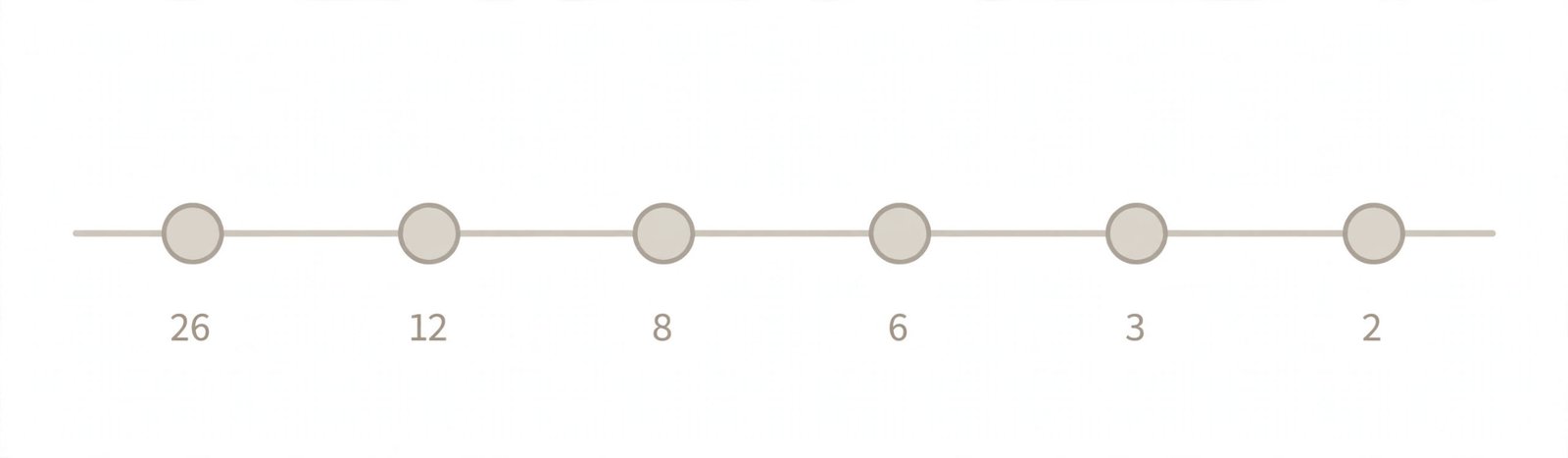
Six dates run the whole invitation process, and each one is counted backwards from the wedding date. Miss one and the next one compresses.
| # | Task | When | Weeks before the wedding |
|---|---|---|---|
| 1 | Send save-the-dates | 6-8 months out | 26-35 weeks |
| 2 | Order invitations | 12-14 weeks out | 12-14 weeks |
| 3 | Address, stamp, and assemble | 8 weeks out | 8 weeks |
| 4 | Mail invitations | 6-8 weeks out | 6-8 weeks |
| 5 | RSVP deadline | 3-4 weeks out | 3-4 weeks |
| 6 | Final guest count to caterer | 2 weeks out | 2 weeks |
The mail date is the anchor. Everything before it exists to make the mail date possible, and everything after it exists to turn replies into a final count. A destination wedding stretches every row: save-the-dates go 10-12 months out and invitations go 10-12 weeks out. The 12-month wedding planning timeline shows where these 6 dates sit inside the full year of planning.
What Date Do You Mail Invitations? Count Back 6 Weeks From Your Wedding Date
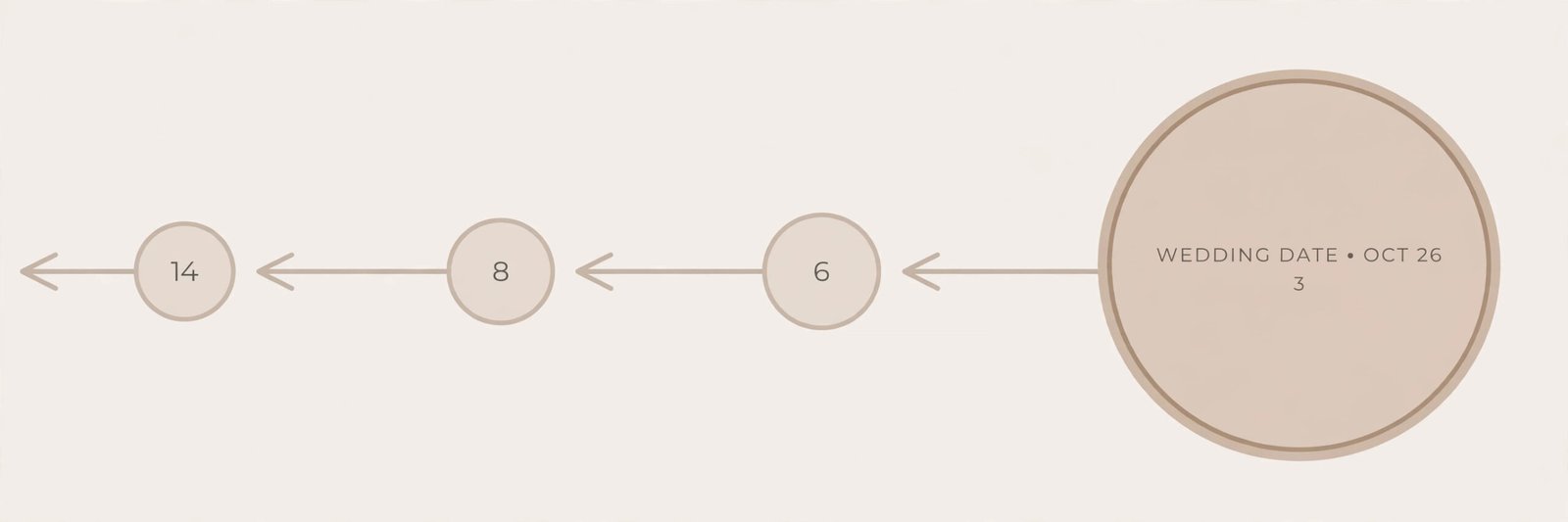
Take your wedding date and subtract 8 weeks for the earliest mail date and 6 weeks for the latest. That 2-week window is your mail window. Mailing inside it gives guests enough time to reply without so much lead time that the invitation gets filed away and forgotten.
| Wedding date (Saturday) | Mail window (8 to 6 weeks before) | Order by (14 weeks before) | RSVP deadline (3 weeks before) |
|---|---|---|---|
| Jan 17, 2026 | Nov 22 – Dec 6, 2025 | Oct 11, 2025 | Dec 27, 2025 |
| Mar 14, 2026 | Jan 17 – Jan 31, 2026 | Dec 6, 2025 | Feb 21, 2026 |
| Jun 13, 2026 | Apr 18 – May 2, 2026 | Mar 7, 2026 | May 23, 2026 |
| Sep 12, 2026 | Jul 18 – Aug 1, 2026 | Jun 6, 2026 | Aug 22, 2026 |
| Oct 10, 2026 | Aug 15 – Aug 29, 2026 | Jul 4, 2026 | Sep 19, 2026 |
| May 15, 2027 | Mar 20 – Apr 3, 2027 | Feb 6, 2027 | Apr 24, 2027 |
Use the same subtraction for any date: wedding date minus 56 days is the earliest mail date, minus 42 days is the latest. Order by the 14-week mark, not the 12-week mark, because production and proofing take 2 to 3 weeks and reprints take another week. A January wedding mails at the 8-week end of the window, because the mail window falls across the holiday rush.
12 to 14 Weeks Before: Order and Proof Your Invitations
Order 14 weeks before the wedding and you have room for 2 rounds of proofing plus a reprint if the first proof has an error. Order 12 weeks before and you have room for 1 round. Order later than 12 weeks and the printer controls your schedule, not you.
The order step has 4 parts, and each one takes days, not minutes. First, finalize the guest list count, because the print run is set by households, not guests: 120 guests usually means 70 to 80 households. Second, approve the proof. Read every name, date, and address on the proof twice, out loud, because the printer prints exactly what you approve. Third, allow 2 to 3 weeks for production and shipping. Letterpress and foil take the longest; flat print takes the least. Fourth, order 10 to 15 extra invitations beyond your household count. Extras cover address errors, damaged envelopes, and the 2 or 3 guests you forgot. Reordering 10 invitations later costs more per piece than adding them to the first run.
8 Weeks Before: Address, Stamp, and Assemble 80 Envelopes
Eight weeks before the wedding, the invitations should be in your hands and the addressing should start. Hand-addressing 80 envelopes takes 3 to 4 hours spread over 2 or 3 evenings, at 2 to 3 minutes per envelope. Assembly — stuffing the invitation, enclosure card, and RSVP envelope, then sealing and stamping — takes about 1 minute per invitation, or 1.5 hours for 80. Budget 5 to 6 hours total for the addressing week, and do it before the mail window opens so the envelopes are ready to post on day 1 of the window.
Weigh one finished invitation before you buy stamps. A 1 oz First-Class letter costs $0.82 with a Forever stamp. Each extra ounce adds $0.29. A square envelope costs $1.31 to mail, and a large envelope starts at $1.63. Most suites with an enclosure card and RSVP envelope weigh 2 oz, so budget $1.11 per invitation in postage. For the worked example below, 80 households at $1.11 is $88.80 out, plus $0.82 per RSVP reply envelope, or $65.60 back, for $154.40 in total postage. First-Class Mail arrives in 1 to 5 business days, so a Friday mailing reaches most guests by the following Wednesday.
6 to 8 Weeks Before: Mail the Invitations
Mail on the first day of your mail window, not the last. Mailing early buys you 2 things: guests get the full reply window, and you get a buffer if the post office returns 2 or 3 envelopes for bad addresses. Hand the finished envelopes to the post office counter clerk in person instead of dropping them in a street box. The clerk weighs a sample, confirms the postage, and postmarks them the same day.
Mail all invitations on the same day. Staggered mailings make the final count harder to close. If 2 or 3 envelopes come back undeliverable, fix the address and re-mail them the same week. A re-mailed invitation still reaches the guest 1 to 5 business days later, inside the reply window, as long as you mailed on time in the first place. Keep a list of every household mailed, the date mailed, and the RSVP status. The wedding guest list template has a column setup for exactly this tracking.
3 to 4 Weeks Before: The RSVP Deadline and the 7-Day Final Count Buffer
Set the RSVP deadline 3 weeks before the wedding. That leaves 7 days to chase the guests who did not reply, and 7 more days before the final count is due to the caterer 2 weeks before the day. The buffer is the point. Without it, every late reply lands on the caterer.
Work the chase in 3 passes. Day 1 after the deadline, send a short message to every household that has not replied: 1 sentence, no guilt, just the date you need the answer. Day 4, call the ones who still have not answered. Day 7, close the list and give the caterer the count. Count a silent guest as a no. Once the count is set, the day itself runs on the wedding day timeline template and the wedding processional order.
5 Exceptions That Move Your Mail Date Earlier
The 6 to 8 week window fits a standard local wedding. Five situations move it earlier, and each one has a fixed rule.
- Destination wedding: mail 12 weeks before. Guests need to book flights and rooms. Send save-the-dates 10 to 12 months out, invitations 12 weeks out, and set the RSVP deadline 6 weeks before the day so you have the count before the venue’s final payment.
- More than 25% of guests live abroad: mail 12 weeks before. International mail takes longer and guests need time for travel documents. Set the RSVP deadline 6 weeks before the day.
- No save-the-dates sent: add 4 to 6 weeks. Without the early warning, the invitation is the first notice. Mail 10 to 12 weeks before the wedding and set the RSVP deadline 4 weeks before the day.
- Holiday weekend wedding: mail at the 8-week mark. Holiday weekends fill calendars first. Mail on the first day of the window, not the last, and set the RSVP deadline 4 weeks before the day.
- Two-wave guest list: first wave 12 weeks, second wave 7 weeks. The first wave gets the full reply window. The second wave must go out at least 7 weeks before the wedding: 4 weeks for the reply plus the 3-week RSVP buffer. Never send a second wave later than 7 weeks out, or the replies arrive after the deadline.
If 2 exceptions apply at once, use the earliest mail date. A destination wedding with no save-the-dates still mails 12 weeks out, because 12 weeks is the earliest rule and the two do not add together.
3 Mistakes That Cost Real Money When You Miss the Date
Missing the mail date costs money in 3 specific ways. Each figure below is a labeled assumption, not a market price, so you can re-do the math with your own numbers.
- Ordering too late triggers rush fees. A standard print run takes 2 to 3 weeks. Order inside 8 weeks and the printer charges a rush fee. Assume a $600 order with a 25 to 50% rush surcharge: $150 to $300 extra. Ordering at 14 weeks avoids the fee entirely.
- Address errors after mailing mean reprints. A wrong address on 20 invitations means 20 reprints plus 20 new stamps. Assume $4 per suite for a rush reprint and $1.11 postage: $102.20 for 20. Proofreading the list twice before ordering is free.
- A late RSVP deadline means a guessed final count. The caterer needs the count 2 weeks before the day. If the RSVP deadline is 1 week before the day, the count is a guess. Assume food and drink at $150 per guest and 10 extra meals ordered to cover the guess: $1,500 of food that may go uneaten. A 3-week RSVP deadline with a 7-day chase turns the guess into a count.
In all 3 cases the late date does not cost the invitation, it costs the fix. Order early, proof twice, mail on day 1 of the window.
Your Printable Mailing Checklist: 12 Tasks With Blanks for Your Dates
Copy this list, fill in your dates, and check each item off as you finish it.
- Wedding date: ______ / Guest count: ______ / Households: ______
- Save-the-dates mailed on: ______ (6 to 8 months before)
- Invitation design approved on: ______ (14 weeks before)
- Print run ordered on: ______ / Quantity ordered: ______ (households + 10 to 15 extra)
- Proof approved on: ______ / Errors found on proof: ______
- Invitations received on: ______ / Damaged or short count: ______
- One finished invitation weighed: ______ oz / Postage per invitation: $______
- Stamps bought: ______ / Total postage cost: $______
- Envelopes addressed and assembled by: ______ (8 weeks before)
- Invitations mailed on: ______ (6 to 8 weeks before)
- RSVP deadline: ______ (3 weeks before) / Non-responders chased by: ______
- Final guest count given to caterer on: ______ (2 weeks before)
Frequently Asked Questions
Hover or tap any question below to reveal the answer.
Can I send wedding invitations 3 months early?
Three months is too early for a standard wedding. Guests file the invitation away and forget the RSVP date. Send save-the-dates 6 to 8 months out instead, and keep the invitation inside the 6 to 8 week window. The one case for 3 months is a destination wedding, where guests need the time to book travel.
What if I did not send save-the-dates?
Without the early warning, the invitation is the first notice your guests get, so mail 10 to 12 weeks before the wedding and set the RSVP deadline 4 weeks before the day.
Do digital invitations follow the same timeline?
Digital replies arrive faster, so the chase is shorter. The one difference is postage: digital invitations cost nothing to send, so the $154.40 postage figure in the worked example drops to zero.
When do I send invitations to out-of-town guests?
If more than 25% of your list lives abroad, mail 12 weeks before and set the deadline 6 weeks before. The extra weeks cover slower mail and the time guests need for travel documents.
What is the latest I can send wedding invitations?
Under 6 weeks, guests do not have time to reply before the RSVP deadline. If you are already inside 6 weeks, mail the same day, set the RSVP deadline 2 weeks before the day, and call the non-responders the day after it passes.
How long do guests have to RSVP?
With a 6 to 8 week mail window and a 3-week RSVP deadline, the reply window is 3 to 5 weeks. State the deadline on the RSVP card in bold, and chase non-responders the day after it passes. A deadline nobody enforces is not a deadline.
Should I send invitations to the B-list later?
Mail the first wave 12 weeks before the wedding and the second wave 7 weeks before. The second wave needs 4 weeks to reply before the 3-week RSVP deadline. Never send a second wave later than 7 weeks out, and never tell a guest they are on a second wave.