

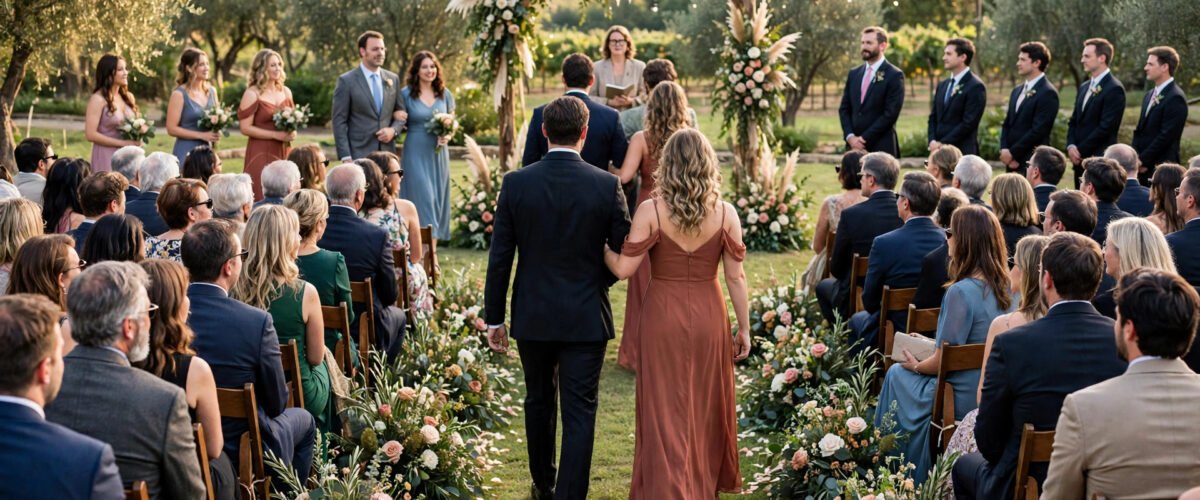
The processional is the first 9 to 21 minutes of your ceremony, and it is the part guests remember most clearly after the vows. Get the order wrong and the music starts before the line-up is ready, the attendants bunch up in the aisle, and the ceremony starts late. This guide gives you the standard order in 8 steps, a timing table built from your party size and aisle length, and a printable rehearsal checklist. Planning takes about 6 hours in total, and 1 hour of that is the rehearsal itself. Start by reading the order of service and timing guide so you know what happens the moment the last person reaches the front.
What Is the Standard Wedding Processional Order in 8 Steps?
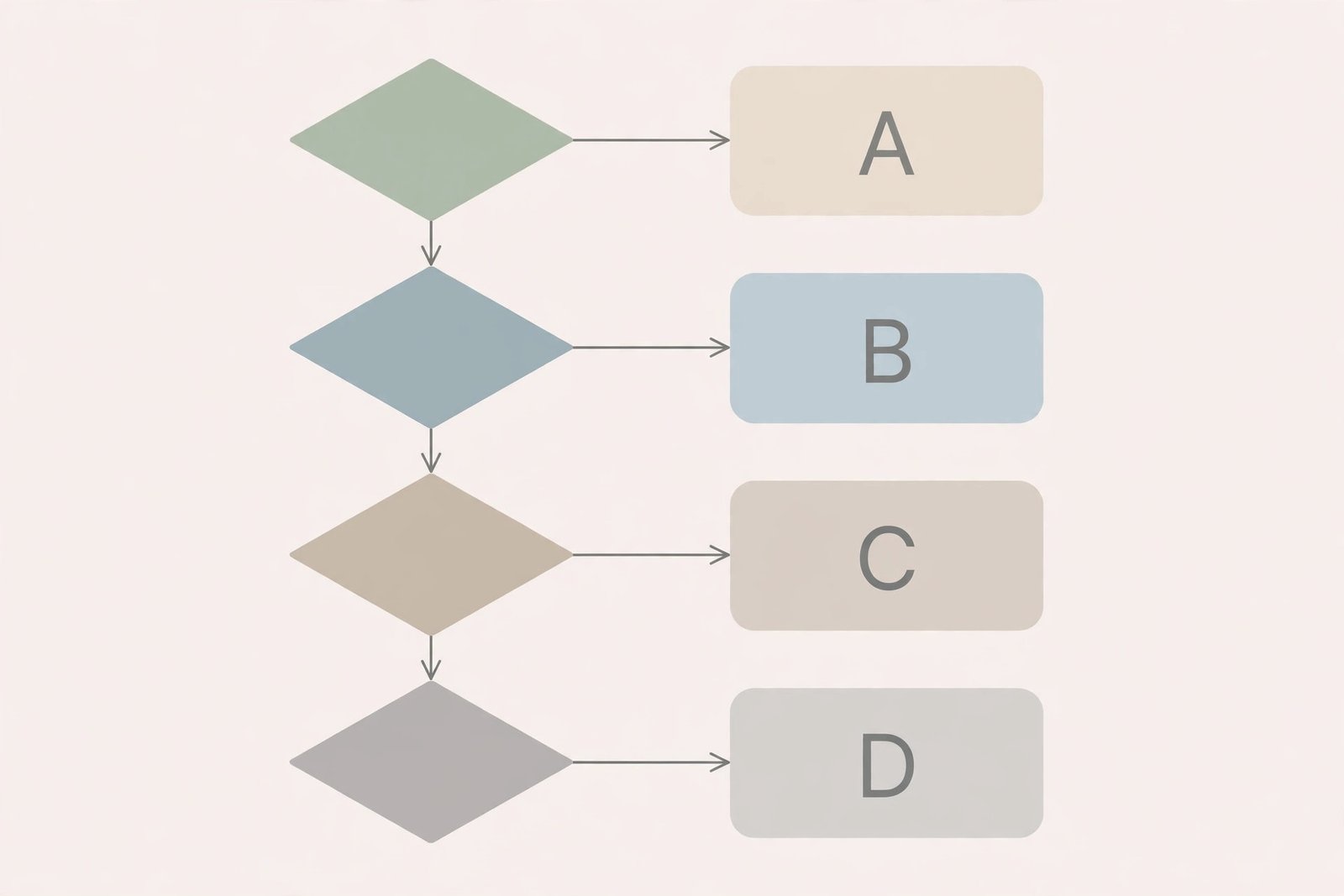
The standard order is: officiant already at the front, grandparents seated, parents seated, attendants, honor attendants, ring bearer and flower girl, then the couple last. The full walk takes 9 to 21 minutes depending on party size, and every guide on page 1 agrees on this sequence as the starting point. Treat it as a first draft, then adjust it with your officiant.
- Officiant takes their place (0 min). The officiant is already at the front when the music starts, entering from a side door or standing there before guests are seated.
- Grandparents are seated (1 min). An usher or a grandchild walks each grandparent to the front row, one side at a time, so nobody walks alone or has to find a seat.
- Parents are seated (2 min). Seat the parents of the partner who waits first, then the parents of the partner who enters last. The last parent to sit tells the room the ceremony is about to begin.
- Attendants walk in (40 sec each). Attendants walk one at a time or in pairs, starting with the person who will stand farthest from the couple. Allow 30 seconds of walking plus a 10-second gap per person.
- Honor attendants walk in (40 sec each). The best man, maid of honor, or honor attendants walk last among the wedding party, alone, and stop closest to the couple.
- Ring bearer walks in (1 min). Children walk slowly, so allow a full minute. Put replica rings on the pillow and let an honor attendant hold the real ones.
- Flower girl walks in (1 min). The flower girl walks last among the children, right before the couple, so any pauses become a warm-up rather than an interruption.
- The couple enters (2 min per entrance). The couple enters last, together or one at a time, and guests stand for this entrance. Allow 2 minutes per entrance, including a pause at the aisle head for photos.
How Long Does a Wedding Processional Take? 9 to 21 Minutes by Party Size
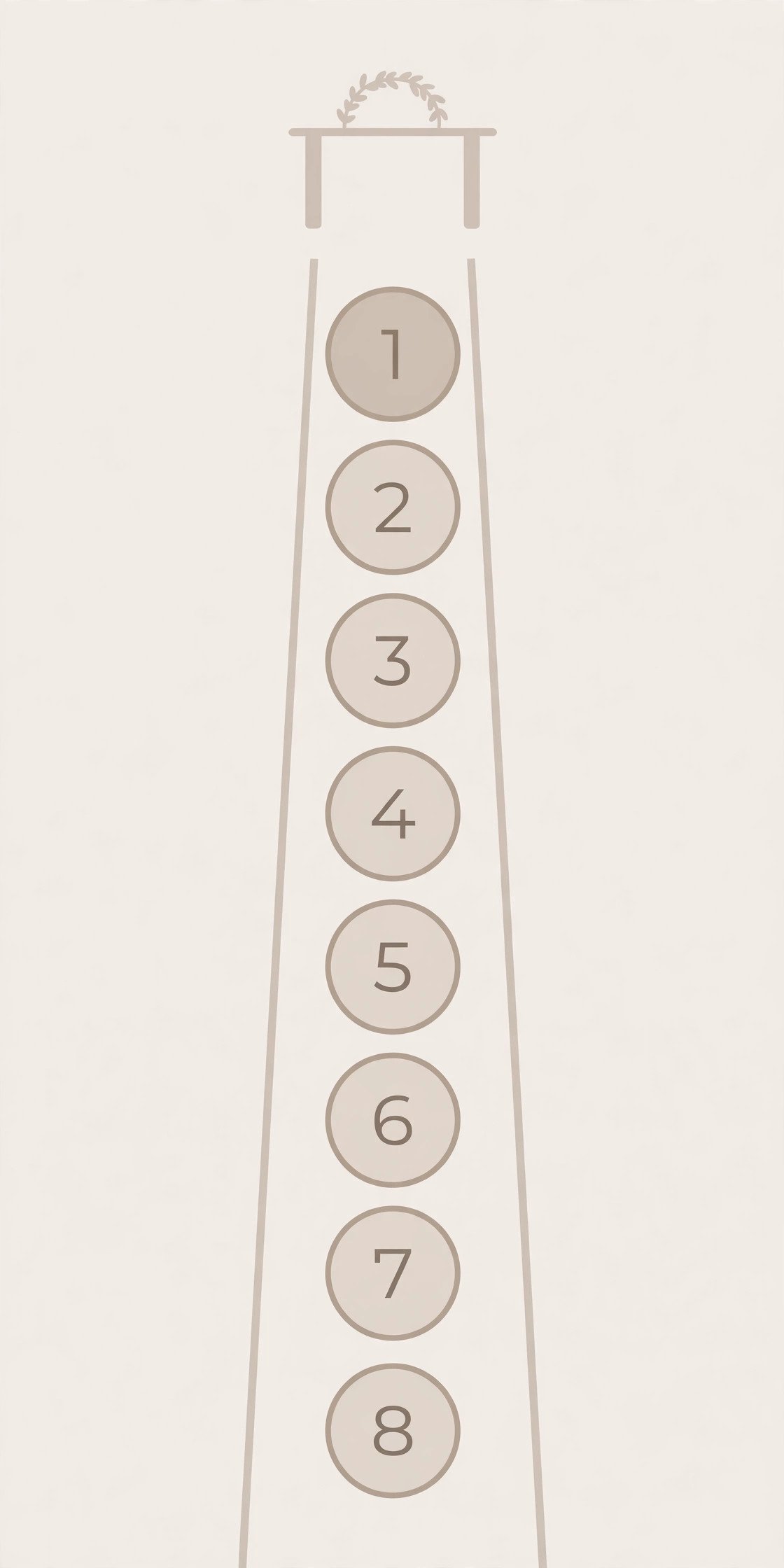
A processional takes 9 minutes with no attendants and 21 minutes with 8 attendants per side on a 60-foot aisle. Each extra attendant adds about 40 seconds. Published ranges look shorter because most guides count only the walking: The Bridal Box gives 3 to 8 minutes and TheWeddingPlanner.ai gives 5 to 10 minutes for the wedding party alone.
The table below is computed from a stated model, not copied from any guide. Assumptions: ceremonial pace of 2 feet per second; a 10-second gap between walkers; family seating of 1 minute for grandparents and 2 minutes for parents; 1 minute per child; 2 minutes per partner entrance; the officiant is already at the front and takes 0 minutes; 60-foot aisle. On a 60-foot aisle, each walker takes 30 seconds to walk plus a 10-second gap, or 40 seconds in total.
| Attendants per side | Total walkers | Attendant minutes | Family + children (5 min) | Couple (4 min) | Total processional | Vows start (4:00 pm ceremony) |
|---|---|---|---|---|---|---|
| 0 | 0 | 0 | 5 | 4 | 9 min | 4:09 pm |
| 2 | 6 | 4 | 5 | 4 | 13 min | 4:13 pm |
| 4 | 10 | 7 | 5 | 4 | 16 min | 4:16 pm |
| 6 | 14 | 9 | 5 | 4 | 18 min | 4:18 pm |
| 8 | 18 | 12 | 5 | 4 | 21 min | 4:21 pm |
Aisle length moves the total by minutes. With 4 attendants per side, the same model gives 13 minutes on a 30-foot aisle, 16 minutes on a 60-foot aisle, and 18 minutes on a 90-foot aisle. Measure your aisle at the venue visit and redo the math with your real number.
Which Processional Order Fits Your Wedding? A 4-Branch Decision Tree
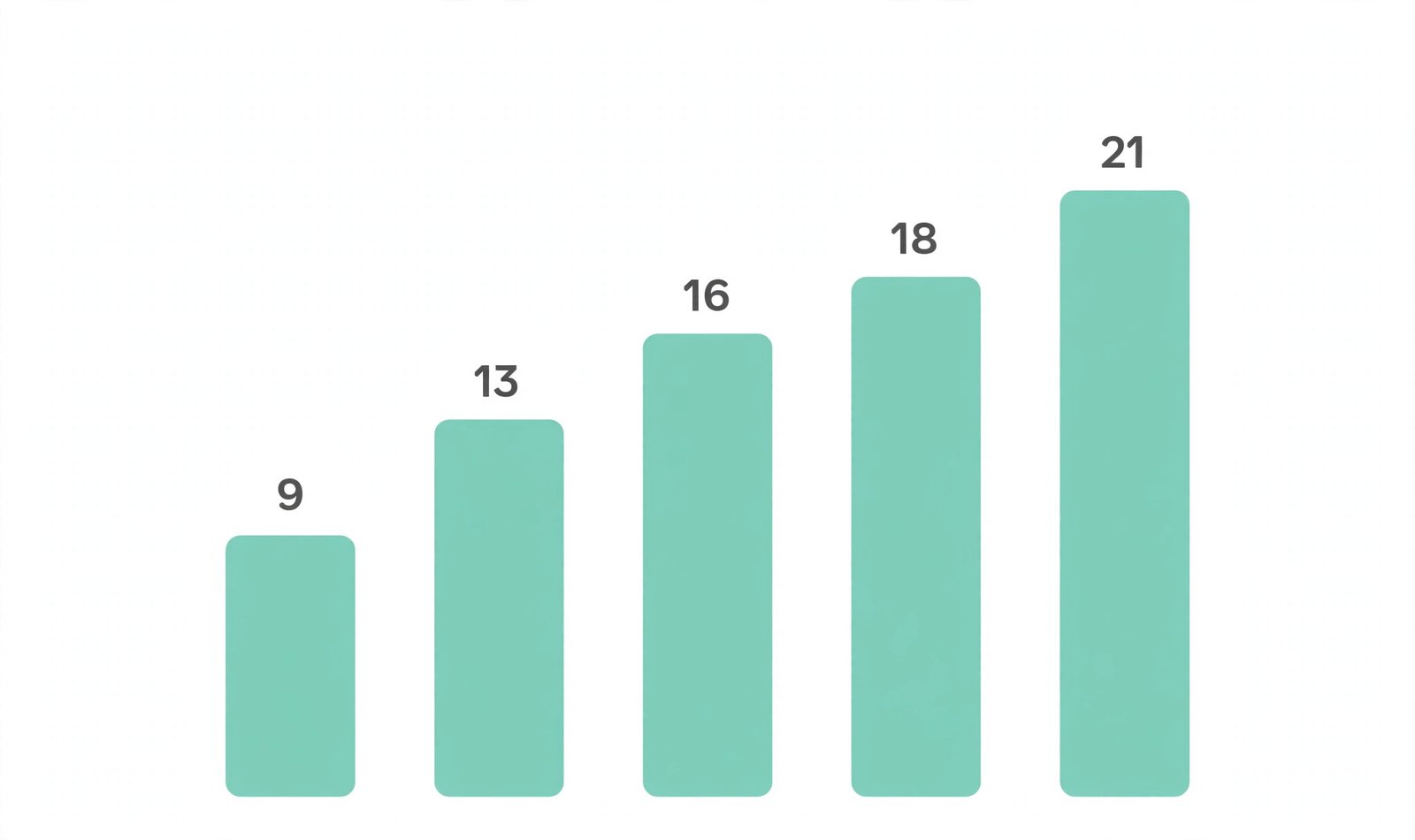
Pick the branch that matches your ceremony type. A set rite follows the officiant, a reveal moment means one partner waits at the front, equal roles mean both partners walk in escorted or together, and a small party means family only plus the couple. Answer the 4 questions in order and you land on one branch.
- Does your tradition or venue require a sequence? If yes, start from that order and adjust only what the officiant allows. Your parish or rabbi will tell you which model they use. If no, go to question 2.
- Who waits and who arrives? One partner waits at the front for a classic reveal moment. Both partners arrive for an equal entrance. If one waits, use branch A. If both arrive, go to question 3.
- Who escorts each partner? One parent, both parents, a grandparent, a sibling, a friend, or nobody. If both families want a visible role, use branch B. If the couple wants to walk in side by side, use branch C.
- How many people walk? Count every walker. With 0 to 2 attendants per side, use branch D. With 3 or more per side, keep the standard order and let the timing table set the music length.
| Branch | Model | Who is at the front first | Who walks last | Works best when |
|---|---|---|---|---|
| A | One partner waits | Officiant and one partner | The other partner, escorted or alone | You want a classic reveal moment |
| B | Each partner escorted | Officiant | Both partners, one after the other, each with family | Both families want a visible role |
| C | Walk in together | Officiant and wedding party | The couple, side by side | You prefer an equal, shared entrance |
| D | Family only | Officiant | The couple, with no attendants | Small party, 0 to 2 attendants per side, or no wedding party |
Branch D is the fastest at 4 minutes, just the two entrances. Branch B is the longest, because two escorted entrances each take 2 minutes plus a pause for the escort to sit down. Tell the DJ or musicians which branch you picked: branches A and B need 2 music pieces, branches C and D need 1.
What Does the Worked Example Look Like for 120 Guests at 4:00 PM?
A full worked example with every assumption stated, so you can redo the math for your own numbers. Assumptions: 120 guests; 4 attendants per side plus 2 honor attendants; 1 ring bearer and 1 flower girl; 60-foot aisle; ceremony at 4:00 pm; 2 music cues.
| Time | Minutes | What happens | Who | Notes |
|---|---|---|---|---|
| 4:00 pm | 0 | Officiant takes their place | Officiant | Already at the front when the music begins |
| 4:00 pm | 1 | Grandparents are seated | Grandparents, ushers | One usher per grandparent |
| 4:01 pm | 2 | Parents are seated | Parents | Last parent seated signals the start |
| 4:03 pm | 5 | Attendants walk in | 8 attendants | 40 seconds each, farthest from the couple first |
| 4:08 pm | 2 | Honor attendants walk in | 2 honor attendants | 40 seconds each, closest to the couple |
| 4:10 pm | 2 | Children walk in | Ring bearer, flower girl | 1 minute each, adult helper halfway |
| 4:12 pm | 2 | First partner walks in | First partner | Music changes to the second piece |
| 4:14 pm | 2 | Second partner walks in | Second partner, escort | Guests stand; pause at the aisle head for photos |
| 4:16 pm | — | Vows begin | Officiant, couple | 16 minutes after the music started |
Total processional time is 16 minutes, matching the timing table for 4 attendants per side. The music plan follows: the first piece must run at least 12 minutes (4:00 to 4:12 pm) or loop, and the second piece must cover 4 minutes (4:12 to 4:16 pm). Tell the musicians the exact minute the piece changes and who the last attendant is before the change. Work the start time backwards into the rest of the day with the wedding day timeline template: hair and makeup, photos, and travel all shift if the ceremony start moves by even 5 minutes.
Where Does Everyone Stand After Walking In? 8 Positions to Mark
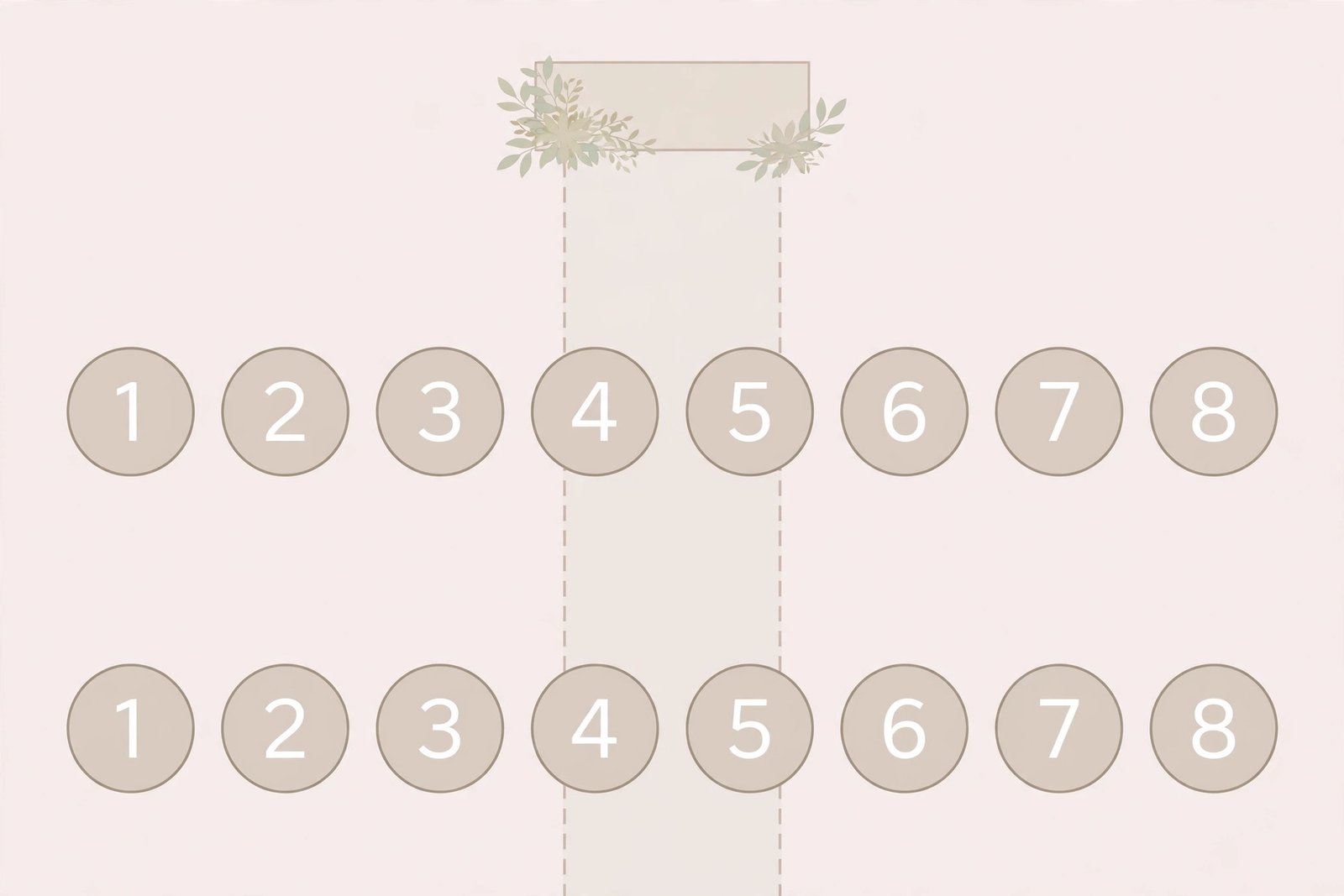
Attendants stand in the order they walked in, farthest first, so each new arrival steps into place without crossing anyone. Honor attendants stand closest to the couple, where they can hold a bouquet, pass the rings, or adjust a veil or jacket. This is the part no guide diagrams: the order you walk in is also the order you stand in. Mark these 8 positions on the floor with tape at the rehearsal, and hand the sketch to the photographer.
- Officiant, center. Faces the guests, with room to step aside for the first kiss photo.
- Partner 1, left of the officiant from the guests’ view. Stands facing the guests with their attendants behind them.
- Partner 2, right of the officiant from the guests’ view. Faces partner 1 across the front.
- Honor attendant 1, closest to partner 1. Holds the bouquet and the rings if the ring bearer is a child.
- Honor attendant 2, closest to partner 2. Holds the rings or the second bouquet.
- Other attendants, fanning out from the honors. First to walk in stands farthest out, so each arrival steps into place without crossing.
- Front row left, partner 1 family. Parents in the first row, grandparents directly behind them.
- Front row right, partner 2 family. Same arrangement, mirrored.
Each partner’s attendants usually stand on that partner’s side, but many couples mix the sides by friendship or height. Either works if the photographer knows in advance. Measure the front area first: 18 people at the front need about 24 feet of width.
What Is the Recessional Order? 6 Steps in Reverse
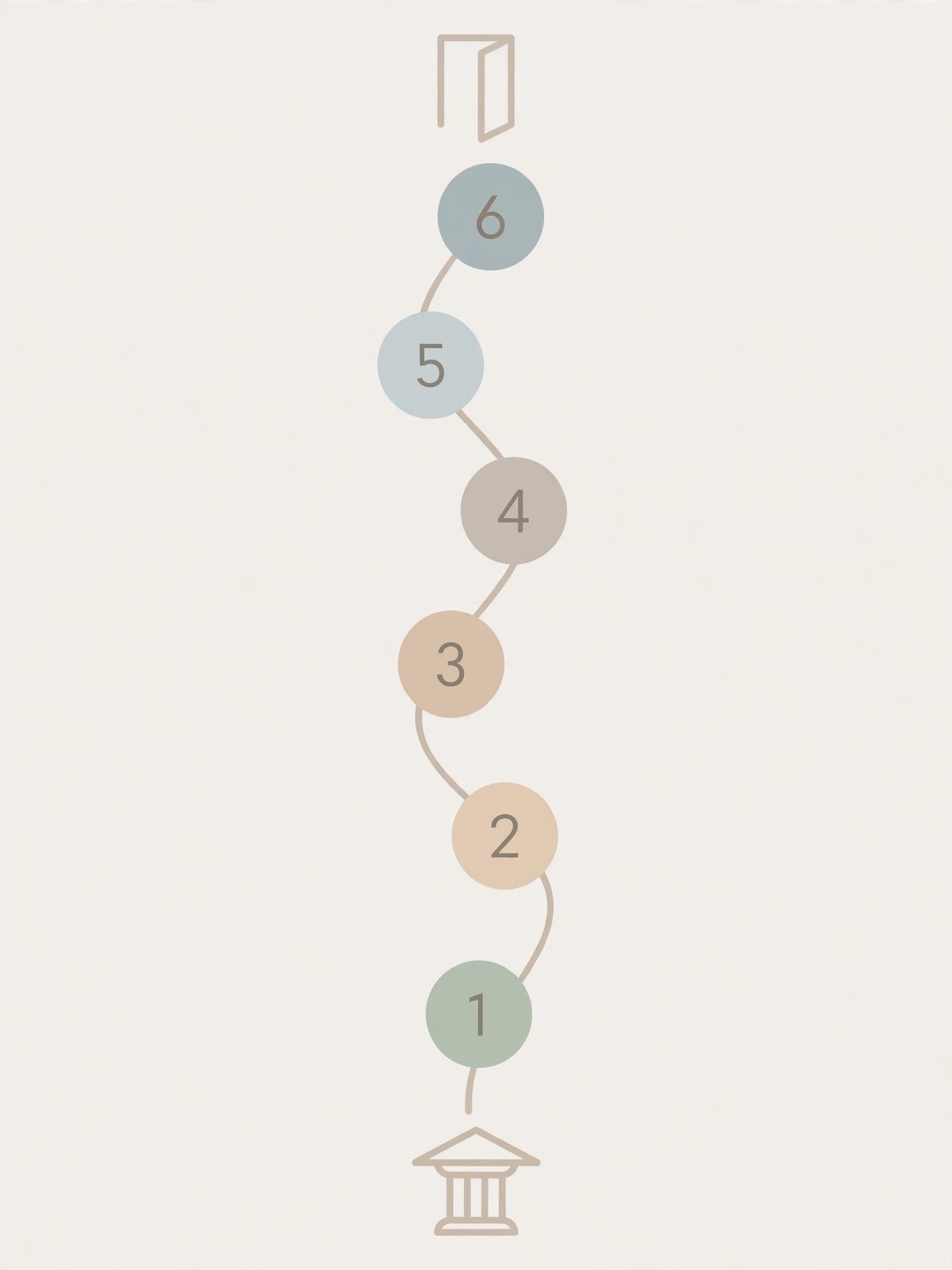
The recessional runs in reverse and takes 3 to 5 minutes: the couple leaves first, then the children, honor attendants, other attendants in pairs, parents, and grandparents. It is simpler than the processional because everyone leaves together instead of one at a time, so allow about 15 seconds per person rather than 40.
- The couple leaves first. They walk out together, pausing briefly at the end of the aisle for the first photo as a married couple.
- Ring bearer and flower girl follow. Only if they are comfortable walking again; otherwise they leave with a parent.
- Honor attendants leave together. The two honor attendants walk out side by side.
- Other attendants leave in pairs. Pairs clear the front twice as fast as single walks.
- Parents are released by the ushers. Ushers dismiss the front rows first, then work backwards through the guest rows to prevent a bottleneck.
- Grandparents leave last. Or they stay seated and leave with the guests if the aisle is long or the walk is tiring.
For Catholic weddings, the Order of Celebrating Matrimony does not mandate a concluding procession, so parishes follow local custom. Decide in advance whether guests stay seated until the wedding party has left, and who announces the next step.
What Goes Wrong Without a Rehearsal? 3 Failure Modes and Their Cost
Skipping the rehearsal is the most common mistake in the guides, and it is also the cheapest to fix: a 20-minute run-through at the venue catches every timing problem below. Each failure mode lists the cost in minutes and the knock-on effect on the rest of the day.
Failure 1: No rehearsal, attendants bunch up. Without a run-through, attendants start walking before the person ahead has cleared the aisle, and the line collapses into a group. Cost: 3 to 5 minutes of dead air, and the ceremony starts late. Knock-on: the photographer loses 5 minutes of portrait time, and cocktail hour starts 5 minutes late. Fix: one 20-minute rehearsal with the real music.
Failure 2: A child freezes halfway down the aisle. The ring bearer or flower girl stops or refuses to walk, and the music keeps playing to a stalled aisle. Cost: 2 to 3 minutes of gap before the final entrance, and a music piece that runs out before the couple walks. Fix: station an adult helper halfway down the aisle, let a very young child walk with an older sibling, and keep the real rings with an honor attendant. Assume your musicians bill overtime at $100 per hour (assumption, not a market rate): a 30-minute overrun adds $50.
Failure 3: The music cue is missed. The final entrance starts on the wrong song, or in silence, because nobody told the musicians who the last attendant is. Cost: 1 to 2 minutes of confusion at the most photographed moment of the day, and the photographer misses the entrance shot. Fix: assign one person to cue starts and fades, print the set list with the last attendant’s name on it, and hand a copy to the officiant, the line-up leader, and the musicians.
How Much Time Does Planning the Processional Take? 6 Hours, DIY vs Coordinator
Planning the processional takes about 6 hours if you do it yourself, and about 2 hours of your time if a coordinator handles the rest. The rehearsal itself is 1 hour on site with everyone present. Book the officiant and the musicians early, because the order and the music cues depend on both of them — see the wedding vendor checklist for the booking order and contract points to confirm.
| Task | Hours | Who does it |
|---|---|---|
| Research the order and pick a branch | 2 | Couple |
| Confirm the order with the officiant | 1 | Couple + officiant |
| Choose music and write the cue sheet | 1 | Couple + musician or DJ |
| Write the one-page order sheet | 1 | Couple or coordinator |
| Rehearsal on site with the music | 1 | Everyone |
| Day-of line-up, 30 minutes early | 1 | Coordinator or ushers |
| Total, DIY | 6 | Couple does it all |
| Total, with a coordinator | 2 of your hours | Coordinator runs the rehearsal and the line-up |
A coordinator saves about 4 hours of your time and removes the day-of cueing from your list. If you skip the coordinator, give the cueing job to one named person — an usher, a sibling, or a friend — and never to the couple.
What Is on the Printable Rehearsal Checklist? 12 Items With Blanks
Print this list and fill in the blanks at the rehearsal. One copy goes to the officiant, one to the person leading the line-up, and one to whoever plays the music. The maid of honor planner covers the honor attendant’s duties in more detail, including the speech and the day-of timeline.
- Ceremony date and start time: __________. Music starts at: __________.
- Aisle length in feet: __________. Walk pace: 2 feet per second (or your rehearsed pace: __________).
- Officiant name: __________. Officiant enters from: side door / already at front (circle one).
- Grandparents seated by: __________. Parents seated by: __________.
- Attendants per side: __________. Walk single / in pairs (circle one). Gap between walkers: __________ seconds.
- Honor attendants: __________ and __________. They walk last and stand closest to the couple.
- Ring bearer: __________. Flower girl: __________. Adult helper halfway: __________.
- First partner enters at: __________. Second partner enters at: __________. Guests stand for: both / second only (circle one).
- Escorts: first partner walked by __________, second partner walked by __________.
- Music piece 1 (family and party): __________. Runs from __________ to __________.
- Music piece 2 (final entrance): __________. Starts when __________ reaches the front.
- Recessional piece: __________. Guests stay seated until: last attendant leaves / couple leaves (circle one).
The 12-month wedding planning checklist puts the processional in its place: the order is set about 1 month out, the rehearsal runs the day before, and the music is confirmed the week of the wedding.
Frequently Asked Questions
Hover or tap any question below to reveal the answer.
Does the groom walk down the aisle?
In many Jewish weddings the groom is escorted to the canopy first, usually by his parents. In other ceremonies he may walk alone, with a parent, or enter from the side with the officiant. Ask your officiant which entrance your ceremony uses.
Can both parents walk the bride down the aisle?
Both parents can escort the bride, or one parent can walk her halfway and the other meet her there. In Jewish ceremonies both parents commonly escort each partner. Confirm any community custom with your officiant first.
Do the flower girl and ring bearer walk together?
Walking together suits very young children, because the older child steadies the younger one. Walking separately gives each child a moment, and takes 2 minutes instead of 1.
What music plays during the processional?
Classical choices include Pachelbel’s Canon in D; many couples use a string quartet cover of a favorite song.
How many songs do you need for the processional?
One piece can cover everything if the party is small, but the final entrance loses its cue without a music change.
Can you skip the wedding party in the processional?
Seat the immediate family before the ceremony and process only the couple. This cuts the processional to about 4 minutes and puts all the attention on your entrance. It also removes 4 hours of coordination from the plan.
Who walks the bride down the aisle if her father is not there?
In a religious ceremony, confirm any community custom with the officiant first, and write the escort’s name on the order sheet.