


A destination wedding is two plans in one: a wedding and a group trip. The couples who enjoy it most start 12 to 18 months out, set the budget before they pick a place, and decide the legal route before they book anything. Get those 3 decisions right and the rest is logistics. This guide covers the full sequence for a 50-guest wedding: budget, legal ceremony or symbolic ceremony, destination, venue, guest travel, and a 3-day wedding week. Start with wedding venue planning to see what a venue tour and contract should cover before you sign.
Editorial Note: This guide was researched and written by our small editorial team under the pen name Claire Sterling. We are researchers and writers, not a wedding planning agency. Prices are typical national ranges, not quotes — confirm locally before you buy.
Before You Start: 6 Decisions That Drive Everything

Decide these 6 things before you look at a single venue: guest count, total budget, legal or symbolic ceremony, destination region, how far guests must travel, and who pays for what. Every later decision hangs off these 6.
- Guest count. Destination lists run 20 to 80 people, against 100 to 150 for a local wedding. Every guest adds a plate, a room night, and a seat on a plane they pay for themselves.
- Total budget. Most couples spend $10,000 to $30,000 all-in. Set the number before the place, not after.
- Legal or symbolic ceremony. A legal ceremony abroad needs residency time and documents. A symbolic ceremony abroad plus a legal signing at home skips most of it.
- Destination region. Flight time for the most guests matters more than the photo backdrop.
- Guest travel distance. If most guests fly 5 or more hours, expect 60 to 70 out of every 100 invited guests to attend a US destination wedding. International destinations often run lower.
- Who pays for what. Couples usually pay for the wedding events. Guests usually pay for their own flights and hotels. Say it in writing early, on the wedding website, so no one guesses.
Step 1: Set the Budget and Guest Count 14 Months Out
Set the total budget first, then the guest count: a 50-guest destination wedding runs $10,000 to $30,000 all-in, and the guest count is what moves that number. Each guest adds about $220 for food and drink in the worked example below, so 10 extra guests add about $2,200 before you count chairs, place settings, and cake.
Venue and food take 40 to 45 percent of the total. Add a 10 percent contingency on top of the subtotal, and add a 3 to 5 percent buffer for exchange rates and bank fees on any deposit paid in local currency. On a $25,000 wedding, that buffer is $750 to $1,250 — money you will be glad you held back when the rate moves between the deposit and the final payment.
Build the total with the wedding budget guide and lock the list with the wedding guest list template. Do not let the guest list grow after the venue is booked: a 50-guest venue cannot hold 65 guests, and the venue will charge for every extra chair.
Step 2: Choose Between a Legal Ceremony and a Symbolic One
A symbolic ceremony abroad plus a legal signing at home is the safer route for most couples. A legal ceremony abroad is possible, but it needs residency time and documents, and the rules change by country.
| Route | Residency needed | Document lead time | Best for |
|---|---|---|---|
| Legal ceremony abroad | 24 hours to 40 days in country, by country | 6 to 9 months | Couples who want one ceremony and one set of paperwork |
| Symbolic ceremony abroad + legal signing at home | None abroad | 2 to 4 weeks at home | Most couples; the lowest-risk route |
| Legal ceremony at home first, celebration abroad | None abroad | 2 to 4 weeks at home | Couples with tight timelines |
Two examples show how wide the range is. France requires about 40 days of residency. The Bahamas requires about 24 hours. The gap between those two numbers is why you check the rules for your exact destination, not for “abroad” in general. If you marry legally on site, hire a local officiant or legal coordinator 6 to 9 months out to review filing deadlines, witness rules, and translation needs. Your home country must recognize the marriage, so confirm that with your local registrar before you book anything.
Step 3: Pick the Destination With 5 Filters
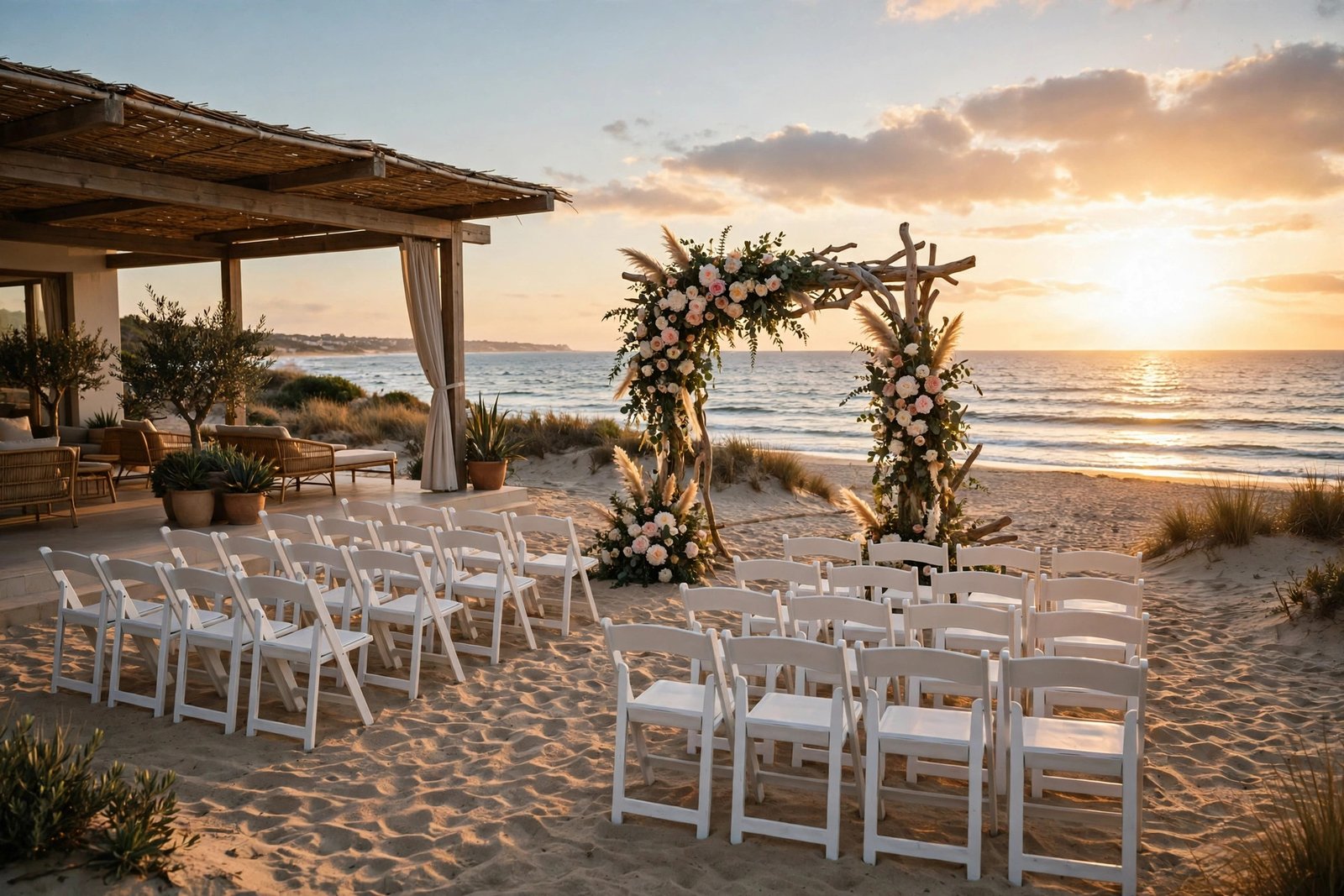
Score each destination on 5 filters and pick the one that passes all 5: flight time, legal ease, weather in your month, venue capacity, and cost per guest. A destination that fails even one filter will cost you later.
- Flight time. Most guests should reach it in under 5 hours, or with 1 connection at most. Every extra connection drops attendance.
- Legal ease. 24 hours to a few days of residency beats 40 days. If the legal route is hard, the symbolic route in Step 2 fixes it.
- Weather. Check the rainy season and hurricane season for your exact month, not the annual average. A “dry season” that ends 2 weeks before your date is not dry for you.
- Venue capacity. The venue must hold your full guest count plus 10 percent for late additions. A 50-guest list needs a venue that holds 55.
- Cost per guest. Compare the all-in per-guest cost across 2 to 3 destinations before you commit. The cheapest venue in the most expensive city is rarely the cheapest wedding.
Shortlist 2 to 3 destinations, then compare them on these 5 filters in a single table. The winner is usually obvious once the numbers sit side by side.
Step 4: Book the Venue and Room Block 12 Months Out
Book the venue 12 to 14 months out and the room block 8 to 10 months out. Ask the venue 6 questions before you sign, and get every answer in writing.
- What is the maximum capacity, and what is the wet-weather backup? If the backup is a tent, ask who pays for it and how fast it goes up.
- What does the package include? Catering, bar, chairs, lighting, sound, and setup. Get the list item by item.
- How many rooms can you hold, and until when? Ask for the release date: the day unbooked rooms go back on sale.
- Which vendors must come from your list, and which can we bring? Some venues charge a fee for outside vendors.
- What are the overtime, service, and cleanup fees? These land on the final invoice, not the quote.
- What is the cancellation policy, and what happens if we move the date? Know the deposit at risk before you pay it.
Take the 27 questions to ask a wedding venue to the tour. A venue that answers all 6 questions in writing is a venue you can trust with a 50-guest event 5,000 miles from home.
Step 5: Manage Guest Travel and Communication for 50 Guests
Send save-the-dates 10 to 12 months out, build a wedding website with travel details, and give guests one deadline for booking rooms. Guests who hear late book late, pay more, and some do not come at all.
The website needs 5 things: flight options and the nearest airport, hotel options at 2 price points, transfers from the airport, the full itinerary, and the RSVP deadline. Update it when anything changes. One page, kept current, beats 5 group chats.
Set the room-block deadline 8 to 10 months out and remind guests twice: once when the block opens, once 2 weeks before it closes. Check passports 9 months out: an expired passport is the most common reason a guest cancels late, and it is the easiest one to prevent. Send the formal invitations on the schedule in when to send wedding invitations.
Step 6: Plan the Wedding Week Across 3 Days

Plan 3 days: a welcome event, the wedding day, and a farewell brunch. Arrive at least 3 to 4 days before the wedding so you can check the venue, meet the vendors, and rehearse on site.
Day 1: welcome drinks, 2 hours, casual. One drink and light food, no speeches, no schedule. Guests meet each other before the wedding day, which makes the ceremony feel like a gathering instead of a performance.
Day 2: the wedding. Ceremony in the late afternoon, cocktails, dinner, dancing. Rehearse the day before, on site, with the full wedding party.
Day 3: farewell brunch, 1 to 2 hours. Light food, no agenda, guests leave when their flights go. It is the cheapest event of the week and the one guests remember most fondly.
Pack with the wedding day packing list and carry the rings, the vows, and any legal documents in your hand luggage, never in checked bags.
The $25,000 Budget for 50 Guests: Line by Line
Here is a full $25,000 budget for 50 guests at a Caribbean resort, with every assumption stated. Say the wedding is at a Caribbean resort for 50 guests over 3 days. The couple flies in and stays 4 nights. Guests pay their own flights and hotels. The venue package covers food, bar, chairs, and lighting. Prices are typical national ranges, not quotes.
| Line item | Amount | Share |
|---|---|---|
| Venue, food, and bar | $11,000 | 44% |
| Photography and video | $2,500 | 10% |
| Couple travel and hotel (4 nights) | $3,000 | 12% |
| Attire (2 outfits + accessories) | $1,500 | 6% |
| Flowers and decor | $2,000 | 8% |
| Music (DJ, 4 hours) | $1,000 | 4% |
| Welcome dinner + farewell brunch | $2,000 | 8% |
| Contingency (about 8%) | $2,000 | 8% |
| Total | $25,000 | 100% |
What the table shows: venue and food is 44 percent, in line with the 40 to 45 percent norm for destination weddings. The couple’s own travel is the second-biggest line at 12 percent — the line local weddings never have. The contingency is the line that saves you when the exchange rate moves between the deposit and the final payment. Re-do this table with your own numbers: change the guest count first, then the venue line, then everything else.
When a Destination Wedding Costs Less: The 50-Guest Crossover
A destination wedding beats a local wedding on cost once the guest list passes about 30 people, because the per-guest cost runs lower even though the fixed costs run higher. Below that line, the local wedding wins.
Assume the destination wedding has $8,000 in fixed costs (venue buyout, couple travel, photographer) plus $250 per guest, and the local wedding has $5,000 in fixed costs plus $350 per guest. Guests pay their own flights and hotels in both cases. Those per-guest figures come from the ranges in this guide: $10,000 to $30,000 all-in for 50 guests abroad, and $280 to $420 per guest for a 100-guest local wedding.
| Guests | Destination total | Per guest | Local total | Per guest | Cheaper by |
|---|---|---|---|---|---|
| 20 | $13,000 | $650 | $12,000 | $600 | Local by $1,000 |
| 50 | $20,500 | $410 | $22,500 | $450 | Destination by $2,000 |
| 80 | $28,000 | $350 | $33,000 | $413 | Destination by $5,000 |
| 120 | $38,000 | $317 | $47,000 | $392 | Destination by $9,000 |
The crossover sits at about 30 guests. Under 30, the fixed costs dominate and the local wedding is cheaper. Above 30, the lower per-guest cost wins, and the gap grows with every guest you add. One warning: if the couple pays for guest flights and hotels, add the full travel cost per guest and the destination wedding costs more at every size. The math above only works because guests pay their own travel.
Common Mistakes and Fixes: 5 Errors That Cost Couples Thousands

Every mistake below has a fix that costs little or nothing. The expensive part is finding out after the deposits are paid.
| Mistake | What it costs | The fix |
|---|---|---|
| Booking the venue before checking legal rules | The ceremony may not count; a second legal ceremony at home costs $25 to $150 plus new paperwork | Decide the legal route in Step 2 first |
| No weather backup in the contract | A rained-out outdoor ceremony eats the $2,000 contingency in the worked example | Get the indoor option in writing before you sign |
| Save-the-dates sent 6 months out | Guests cannot get time off or cheap flights; 10 empty seats at $250 each is $2,500 of food you already paid for | Send save-the-dates 10 to 12 months out |
| No local coordinator on site | A vendor no-show from 5,000 miles away has no backup | Hire a local planner or day-of coordinator |
| Forgetting currency and bank fees | Deposits in local currency move 3 to 5 percent; on $25,000 that is $750 to $1,250 | Build a 3 to 5 percent buffer into the budget |
Time and Cost Budget: 40 Hours of Planning and $10,000 to $30,000
Plan on about 40 hours of work across 14 months, and $10,000 to $30,000 all-in for 50 guests. The worked example in this guide is $25,000. A local planner or day-of coordinator on site cuts the couple’s hours roughly in half, and costs far less than a single vendor mistake.
| Task | Hours | Who |
|---|---|---|
| Budget + guest list | 4 | Couple |
| Legal research | 3 | Couple + local coordinator |
| Destination + venue | 8 | Couple + planner |
| Vendor booking | 6 | Couple + planner |
| Guest communication | 6 | Couple |
| Website + invitations | 4 | Couple |
| Travel week, on site | 9 | Couple + coordinator |
| Total | 40 hours |
The travel week is the biggest block at 9 hours: venue check, vendor meetings, rehearsal, and the 3 days of events. Everything before that is email and calls. Start 14 months out and the 40 hours spread to about 3 hours a month. Start 6 months out and the same 40 hours land in 7 hours a month, on top of everything else in your life.
Frequently Asked Questions
Hover or tap any question below to reveal the answer.
How far in advance should you plan a destination wedding?
That gives guests time to book flights and hotels, and gives you time to compare venues and sort the legal paperwork. Shorter timelines work for small guest lists and domestic destinations.
Is a destination wedding cheaper than a local wedding?
The per-guest cost runs lower, but the fixed costs run higher, so small weddings can cost more abroad. Guests usually pay their own travel.
Are destination weddings legally binding?
Some countries need weeks of residency and months of document preparation. A symbolic ceremony abroad plus a legal signing at home is legally binding at home and skips most of the paperwork.
Who pays for guest travel at a destination wedding?
The couple pays for the wedding events: the ceremony, reception, welcome dinner, and farewell brunch. Say it clearly on the wedding website.
How many guests usually come to a destination wedding?
International destinations often run lower. Invite 10 to 15 percent more people than your target headcount.
When do you send save-the-dates for a destination wedding?
Guests need the date early to request time off work and book flights before prices climb.