

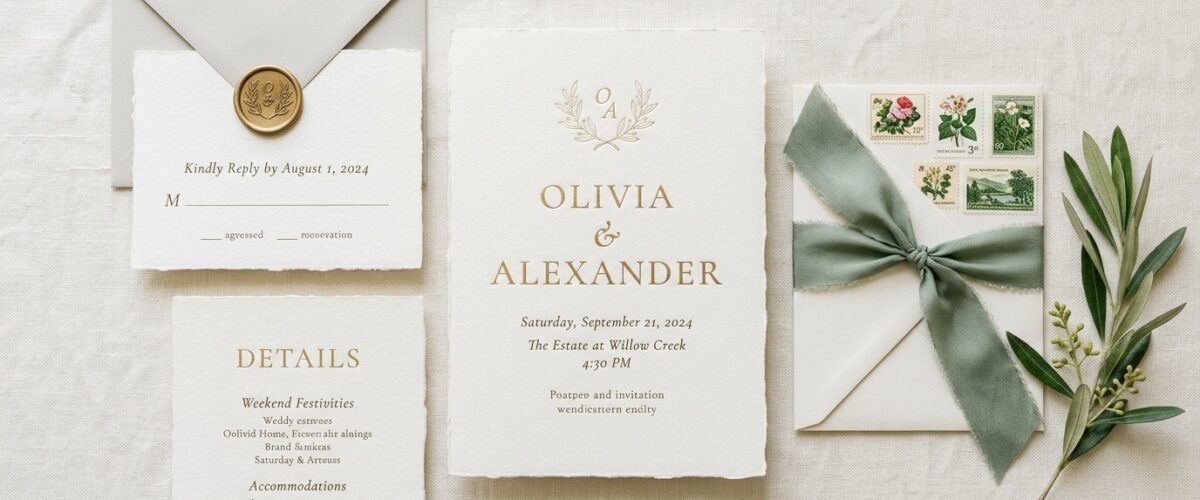
Knowing exactly what to include in wedding invitation suites ensures your guests receive critical logistical details while preventing costly reprinting fees and postal delays. A standard wedding invitation suite contains five core elements: the main invitation card, a response card with a pre-addressed envelope, an accommodations card, a reception details card, and the outer mailing envelope. Domestic invitations must arrive eight to ten weeks before your ceremony. In contrast, destination events require a twelve to sixteen-week notice. Omitting essential enclosures creates chaos. Consequently, you must answer repetitive guest inquiries while risking catering deadlines.
As a lead wedding coordinator with fourteen years managing high-stakes celebrations, I audit dozens of wedding stationery proofs every season. Couples spend thousands on luxury paper yet forget reply deadlines. Additionally, many fail to weigh their assembled suite at the post office. When you organize your invitation suite with disciplined planning, your guests respond promptly and arrive on time. This comprehensive guide details what to include in wedding invitation packages, including enclosure card ticklists, wording formulas, addressing etiquette, and mailing protocols.
What to Include in Wedding Invitation Suites: Master Enclosure Checklist
First, before ordering your paper suites from a stationery designer or printing house, audit your required components against standardized industry benchmarks. Standardizing your stationery elements prevents costly rush reprints and keeps your mailing assembly organized.
| Enclosure Component. | Primary Functional Purpose. | Standard Physical Dimensions. | Mailing Weight Impact. | Lead Coordinator Production Rule. |
|---|---|---|---|---|
| Main Invitation Card.. | States couple names, hosts, ceremony date, exact time, and venue location. | 5 x 7 inches (A7 format). | Primary weight base (typically 120 lb to 240 lb stock). | Keep text strictly limited to ceremonial details without registry or attire notes. |
| Response Card (RSVP).. | Collects formal attendance counts, meal selections, and guest names. | 3.5 x 5 inches (A4 or 4-bar format). | Adds approximately 0.25 ounces to the total suite weight. | Set deadline exactly four weeks prior to your caterer final headcount lock. |
| Response Return Envelope.. | Delivers completed physical reply cards back to the couple or host. | 3.625 x 5.125 inches. | Includes mandatory pre-applied domestic postage stamp. | Pre-print the return address cleanly to prevent postal carrier misrouting. |
| Reception Details Card.. | Clarifies reception location, cocktail hour timing, and adult-only receptions. | 4 x 6 inches or 3.5 x 5 inches. | Adds minimal paper weight on standard 110 lb cover. | Mandatory if the reception occurs at a separate geographical property. |
| Accommodations Card.. | Lists hotel room block names, discount group codes, and booking cutoff dates. | 3.5 x 5 inches. | Adds standard single-sheet insert weight. | Always state the hotel release date when discounted rates expire permanently. |
| Attire & Logistics Card.. | Specifies formal dress codes, shuttle bus schedules, and parking instructions. | 3.5 x 5 inches or 4 x 4 inches. | Optional standalone sheet or combined with accommodations. | Clarify grass-friendly footwear guidelines for garden or outdoor lawn ceremonies. |
| Wedding Website Insert.. | Directs guests to digital portals for registry lists and travel FAQs. | 2.5 x 3.5 inches (business card format). | Negligible weight addition. | Include custom short URL and QR code for instant smartphone scanning. |
| Inner Envelope.. | Protects delicate cards and explicitly names every invited family member. | 5.25 x 7.25 inches. | Increases outer envelope thickness and rigidness. | Write individual child names to eliminate ambiguous plus-one assumptions. |
| Outer Mailing Envelope.. | Bears the formal delivery address, return address, and official postage. | 5.5 x 7.5 inches. | Contains the entire assembled stationery package. | Always request manual hand-canceling at your local post office counter. |
| Belly Band or Silk Ribbon.. | Secures loose enclosure cards into a unified, tidy presentation. | 1.5 x 11 inches paper band or silk tie. | Wax seals on ribbon often trigger non-machinable postal surcharges. | Verify that wax seal height stays under one-quarter inch to prevent jams. |
Related: Maid of Honor Planner: Complete Duty Checklist, Timeline, and Speech Guide
The Anatomy of the Main Invitation Card: Non-Negotiable Information
Specifically, the main invitation card acts as the ceremonial centerpiece of your stationery suite. Therefore, you must present essential logistical data clearly while respecting established formal conventions. Every line of text on this card serves an intentional communicative purpose.
Host Line Formulas and Family Dynamics
First, determine the host line based on financial contributions and family preferences. Traditionally, the host line indicates who finances the wedding reception. If the bride parents host entirely, the card begins with Mr. and Mrs. Arthur Hayes request the pleasure of your company. In contrast, if both families contribute equally, use the inclusive phrase Together with their families. Additionally, if the couple finances the celebration independently, start directly with the couple names or use At the marriage of. Clarifying the hosting language early avoids familial tension. In addition, it sets the formal tone for the celebration.
Request Lines: Religious vs Secular Wording Protocols
Next, align your request line with the architectural nature of your venue. If you hold your ceremony inside a consecrated house of worship, tradition dictates using request the honor of your presence. In contrast, estate and garden weddings use different wording. Specifically, use request the pleasure of your company for secular celebrations. Consequently, matching your phrasing to the venue style demonstrates thoughtful etiquette and prepares guests for the ceremonial environment.
Couple Identification and Full Legal Name Conventions
Then, format the couple names with appropriate typographic hierarchy. In traditional suites, the bride names appear without a surname. This convention applies because her parents share the family name on the host line. In contrast, the groom full legal name appears with title and middle name. For modern weddings and same-sex couples, both partners display their full first, middle, and last names prominently. Utilizing full legal names prevents confusion when distant relatives or mutual acquaintances receive their formal invitations.
Date and Time Wording: The Fifteen-Minute Arrival Buffer
Additionally, write out numbers, days, and times in full words rather than numeric digits on formal invitations. For example, write Saturday, the eighteenth of October, two thousand twenty-six, at four o’clock in the afternoon. Never list am or pm on formal stationery. additionally, always print the true planned ceremony start time. Some couples print an early start time to catch tardy guests. However, this tactic frustrates punctual guests. Consequently, guests must sit awkwardly for half an hour. Instead, coordinate with your ushers. Specifically, instruct ushers to close chapel doors five minutes before processional music begins.
Location Formatting and Physical Venue Addresses
Finally, format the ceremonial location with exact physical specifications. State the venue official name, city, and state clearly. For example, print The Grand Estate, Charleston, South Carolina. Omit postal street addresses and zip codes from formal invitation cards. This holds true unless celebrating at a private residence lacking a sign. Providing the clean venue title keeps the main card elegant. Consequently, digital wedding websites handle technical turn-by-turn navigation.
Response Card Mechanics: Maximizing RSVP Accuracy
Your response card represents the operational engine of your wedding planning timeline. Without timely RSVPs, you cannot finalize seating charts or purchase floral rentals. In addition, you cannot submit contracted food guarantees to your caterer. Structuring this card with precision prevents administrative bottlenecks.
RSVP Deadline Calculation: The Four-Week Catering Window
First, schedule your RSVP deadline exactly four weeks prior to your wedding date. Professional catering contracts require a firm, locked-in guest headcount guarantee fourteen to twenty-one days before the event. Setting your reply deadline four weeks out provides a vital buffer. Specifically, you gain seven to fourteen days of coordination time. This buffer window allows you to track down unresponsive guests. Consequently, you submit an accurate final catering roster. If you set deadlines too late, problems escalate. You face frantic calls and penalty surcharges from your banquet facility.
Meal Selection Formatting and Dietary Allergy Prompts
Second, provide clear meal selection checkboxes if hosting a plated dinner reception. List each entree choice with its primary protein and preparation style, such as Rosemary Crusted Filet Mignon, Pan-Seared Atlantic Halibut, or Roasted Butternut Squash Risotto. In addition, include a line for guests to initial meal preferences. This clarity helps when multiple attendees share a single card. additionally, provide a blank prompt line reading Please indicate any severe dietary allergies or restrictions. Gathering food allergy data early protects guest health. Consequently, banquet chefs prepare customized allergen-free dishes safely.
Explicit Plus-One Line Wording That Prevents Awkward Additions
Third, eliminate ambiguity regarding who receives an invitation. Unchecked plus-ones represent a major financial hazard. Specifically, uninvited companions inflate catering expenses unexpectedly. To prevent unwanted additions, print pre-assigned number fields on each reply card. For example, include the phrase We have reserved ___ seats in your honor, and hand-write the exact allocated number before mailing. Alternatively, print an explicit response line reading M___________________, followed by Accepts with pleasure or Declines with regret. Printing individual guest names directly on envelopes prevents confusion. Consequently, acquaintances cannot add uninvited companions or children.
QR Code vs Physical Card RSVP Return Rates
Finally, decide between traditional postal response cards and modern digital RSVP portals. Traditional physical response cards yield high completion rates. Particular, older relatives appreciate pre-stamped return envelopes. In contrast, digital RSVP cards appeal to younger guests. In addition, scannable QR codes reduce printing expenses significantly. For optimal results, consider a hybrid approach. Include a physical reply card for family and mature guests. Meanwhile, direct general attendees to an online portal with an intuitive QR code.
Essential Secondary Enclosure Cards: When and How to Use Them
Understanding what to include in wedding invitation suites requires managing secondary enclosure cards thoughtfully. Secondary cards convey vital logistical instructions without cluttering the aesthetic presentation of the primary invitation card.
Reception Card Timing and Location Clarifications
First, include a separate reception card whenever your dinner celebration takes place at a different venue than your ceremony. For example, a chapel ceremony might conclude hours before dinner. In this scenario, guests require explicit transition instructions. State the cocktail hour commencement time, dinner service hour, and reception venue address clearly. For example, print Reception immediately following ceremony, or Cocktail hour begins at five o’clock in the evening at the Club Ballroom. Clarifying this schedule prevents guests from arriving prematurely at an unstaffed reception property.
Accommodations and Room Block Instructions
Second, provide an accommodations enclosure card for weddings hosting out-of-town travelers. List two or three partner hotels offering negotiated group discount rates across varying price tiers. Include the exact hotel group booking code, direct telephone reservation line, and the room block expiration date. Most hotels release unbooked discount rooms thirty to forty-five days prior. Consequently, room blocks expire permanently after this cutoff. Stating this cutoff deadline encourages guests to book early. Consequently, attendees avoid expensive regional room rate surges.
Attire and Dress Code Clarification Rules
Third, define the expected guest dress code on a details card or within your accommodations insert. Guests appreciate clear sartorial guidance when preparing for formal events. Use recognized industry terminology such as Black Tie, Black Tie Optional, Formal Attire, or Cocktail Attire. Outdoor celebrations require practical advice. For example, warn guests if the ceremony takes place on a lawn or sandy beach. For example, write The ceremony will take place on a grass lawn; block heels or wedges are recommended. Providing practical advice protects guests from sinking into damp turf during cocktail hour.
Wedding Website Card: Consolidating Registry and Logistics
Finally, utilize a compact details card to direct guests to your master wedding website. A wedding website houses dynamic information. For example, websites share interactive maps, weekend itineraries, and transit recommendations. Print your clean vanity URL prominently, and incorporate an unobtrusive QR code. Consolidating ancillary details onto your digital portal keeps your physical paper suite refined and lightweight.
What NOT to Include in Your Wedding Invitation Suite
Additionally, knowing what to omit from your stationery suite is just as important as knowing what to include in wedding invitation mailings. Traditional etiquette establishes strict boundaries regarding commercial transactions and delicate social boundaries.
Direct Registry Mentions on Formal Cards
First, never print retail registry information or gift wish lists on formal invitation cards. In traditional etiquette, an invitation requests attendance at a sacred ceremony. It does not solicit household goods or cash gifts. Printing registry details on formal stationery appears transactional. Instead, etiquette dictates keeping retail requests separate. Instead, post registry links exclusively on your wedding website. Additionally, family members can share registry links when guests inquire directly.
Adults-Only Phrasing Mistakes and Diplomatic Alternatives
Second, avoid printing blunt phrases like No children allowed or Adults only on your main invitation card. Negative phrasing creates an unwelcome tone for family members. Instead, establish adult-only boundaries diplomatically through your envelope addressing and response cards. Address envelopes exclusively to the parents, such as Mr. and Mrs. David Clark, rather than The Clark Family. additionally, reinforce this boundary on the RSVP card with the pre-printed line We have reserved 2 seats in your honor. Additionally, you can add a polite note on your wedding website FAQ section reading While we love your little ones, our reception is an adult-only celebration.
Exact Driving Directions in the Era of Digital Maps
Third, eliminate extensive printed driving maps and turn-by-turn text directions from your enclosure card order. In previous decades, multi-page direction cards were standard practice. However, modern travelers rely universally on smartphone GPS applications and real-time navigation platforms. Printed driving directions quickly become obsolete during highway road construction or unexpected traffic detours. Eliminating unnecessary map cards reduces your printing bill and prevents excessive envelope weight at the post office.
Mailing Logistics, Postage Weight, and Post Office Hand-Canceling
Mailing mistakes can derail your wedding stationery timeline and trigger costly return-to-sender delivery failures. Taking proactive precautions with postal regulations ensures your invitations arrive in pristine condition.
The Two-Ounce Postage Trap: Wax Seals and Silk Ribbons
First, never estimate postage rates based on standard one-ounce letter stamps. A multi-piece suite containing heavy cardstock and ribbon easily exceeds one ounce. Consequently, standard postage stamps will not suffice. In addition, decorative embellishments like wax seals, velvet ribbons, or acrylic cards push packages into higher rate categories. If your envelope exceeds one ounce, purchase two-ounce postage stamps. Insufficient postage triggers severe delays. The post office returns marked envelopes, damaging paper and delaying delivery by weeks.
Square Envelope Surcharges and Rigid Card Inspections
Second, recognize that non-standard envelope shapes trigger significant postal surcharges. Automated sorting machines at postal processing centers process standard rectangular mail efficiently. In contrast, square envelopes cannot pass through automated sorting belts. Rigid packages also jam standard sorting rollers. The postal service classifies square envelopes as non-machinable. Consequently, clerks assess an automatic surcharge per piece. Always verify envelope aspect ratios with your stationer before placing bulk orders.
How to Request Post Office Hand-Canceling
Finally, take a fully assembled sample suite to your local post office counter for official inspection and hand-canceling. Hand-canceling involves a clerk manually stamping each envelope. This step bypasses high-speed mechanical sorting rollers completely. Mechanical sorting rollers apply immense pressure. Consequently, machines can shatter wax seals and smudge bridal calligraphy. While some postal branches charge a nominal fee for hand-canceling large batches, this service protects your expensive stationery investment.
Addressing Conventions and Outer Envelope Assembly Order
Specifically, the visual presentation and structural assembly of your invitation suite establishes your event aesthetic before the envelope is opened. Following proper stacking hierarchy ensures an elegant unboxing experience for your guests.
Outer Envelope Stacking Order From Bottom to Top
First, assemble your stationery pieces using the correct chronological stacking order. Place the main invitation card at the bottom of the stack. This orientation depends on whether you use an inner envelope. Next, stack the largest enclosure card directly on top of the main invitation. Next, stack smaller inserts in descending order of size. Specifically, place accommodations and details cards on top of larger sheets. Finally, place the response card on the very top. Specifically, tuck the reply card beneath the flap of its return envelope. When guests open the envelope, the couple names and main invitation greeting appear immediately.
Formal Addressing Etiquette for Married, Single, and Professional Titles
Second, address outer envelopes with accurate social and professional titles. For married couples sharing a last name, use Mr. and Mrs. Jonathan Miller. If the wife retains her maiden name, list both names clearly. For example, write Ms. Sarah Jenkins and Mr. Jonathan Miller. additionally, honor professional titles accurately. If one partner is a medical doctor, list the physician first, such as Dr. Emily Bennett and Mr. Michael Bennett. For unmarried guests granted a companion, write the guest name followed by and Guest on the inner envelope to maintain clear social boundaries.
Handling International Addresses and Return Address Positioning
Finally, ensure all return addresses and international destinations comply with international shipping standards. Print your return address on the back envelope flap of the outer envelope. For destination guests, write the destination country name in capital letters on the bottom line of the address block. In addition, do not place domestic postage stamps on response envelopes mailed to international attendees. United States stamps cannot be used from overseas. Consequently, foreign postal authorities reject domestic stamps on return letters. Instead, direct international guests to submit their RSVPs through your digital wedding website portal.
Mastering what to include in wedding invitation suites transforms your stationery into an efficient logistical communication tool. By auditing your enclosure cards, calculating precise RSVP deadlines, respecting traditional wording conventions, and verifying postal weight requirements, you eliminate confusion for your guests and protect your wedding timeline. Approach your invitation assembly with meticulous attention to detail, and enjoy the peace of mind that comes with an organized, beautifully executed wedding paper suite.
Invitation Timing, Wording, and Stationery
The suite is only half the job. When you send it, how you word it, and what you put on the website card decide whether guests arrive on time and reply at all.
When to Send Wedding Invitations and How to Address Wedding Announcements
When to send wedding invitations: mail them 8 to 10 weeks before the ceremony, or 12 to 16 weeks before for a destination wedding. The mailing sits in the six-month planning window, so check our 6-Month Wedding Planning Checklist for the full timeline. How to address wedding announcements: announcements go out after the wedding, to people who were not invited, and use the same formal outer-envelope addressing as invitations, with the couple’s names and the wedding date on the card.
Wedding Invitation Wording, Proper Way to Write Date and Time on Invitation, and How to Put Dress Code on Invitation
Wedding invitation wording follows a fixed order: host line, request line, couple names, date and time, and location. The proper way to write date and time on invitation is to spell them out: “Saturday, the twenty-first of June, two thousand twenty-six, at four o’clock in the afternoon.” How to put dress code on invitation: put it on the details card, not the main card, in one line such as “Black Tie” or “Cocktail Attire.”
What to Include on Wedding Website, Handmade Wedding Invitation Cards, RSVP Card Size, and Creative Wedding Stationery
What to include on wedding website: the schedule, the venue address, travel and hotel details, the registry link, and an FAQ page. Handmade wedding invitation cards use letterpress, hand-torn edges, or pressed flowers, and they cost more per piece than printed suites, so order extras for mistakes. RSVP card size is usually 3.5 by 5 inches, small enough to fit the suite and large enough for the meal choice. Creative wedding stationery includes illustrated maps, custom monograms, wax seals, and vellum wraps, but keep the main card readable and the reply deadline clear.
Frequently Asked Questions
Hover or tap any question below to reveal the answer.
How many pieces should be included in a wedding invitation suite?
Destination weddings often add a weekend itinerary card.
When should you mail your wedding invitations?
For destination weddings or holiday weekend dates, send invitations twelve to sixteen weeks in advance to accommodate guest travel bookings.
Do you put registry information on a wedding invitation?
Direct guests to your registry by including your wedding website address on a separate details insert.
How do you politely say no kids on a wedding invitation?
In addition, state on your website FAQ that the reception is an adult-only celebration.
Do wedding response cards need stamps?
Providing pre-paid return envelopes ensures higher and faster RSVP completion rates.
What makes a wedding invitation non-machinable?
These items require specialized manual postal handling and an additional surcharge.
What size is an RSVP card?
It fits inside the invitation suite and leaves enough room for the guest’s name, the meal choice, and any dietary notes.


