

Running out of alcohol at 9:30 PM is a nightmare, but returning 18 unopened cases of Pinot Noir on Monday morning is a terrible way to spend your budget. The standard formula most venues give you assumes everyone drinks identical amounts of cheap house red. That is not how a real crowd behaves.
Buying alcohol for a wedding requires three pieces of math: your guest count, the duration of the open bar, and your crowd’s drinking preference. Once you have those, you can calculate your bottle counts down to the case and save between $1,200 and $2,800 by purchasing your own inventory instead of paying venue per-person bar packages.
The Standard Alcohol Formula: The One-Drink-Per-Hour Rule
Every professional catering calculation starts with the standard baseline: plan for two drinks per guest during the first hour (cocktail hour), and one drink per guest for every hour after that.
For a standard 4-hour reception:
- Hour 1 (Cocktail Hour): 2 drinks x 100 guests = 200 drinks
- Hour 2 (Dinner service): 1 drink x 100 guests = 100 drinks
- Hour 3 (Dancing & party): 1 drink x 100 guests = 100 drinks
- Hour 4 (Final hour): 1 drink x 100 guests = 100 drinks
- Total Estimated Drinks: 500 drinks
If you prefer a fast rule of thumb without doing multi-tier math, multiply your adult guest count by the total hours, then add 10% to 15% as a buffer. For 100 guests over 4 hours, that is 100 x 4 x 1.15 = 460 drinks. The hour-by-hour method above gives 500 drinks, so plan for 460 to 500 drinks and buy toward the higher number.
How to Adjust the Formula for Your Crowd: 460 or 500 Drinks?
Buy toward 460 drinks for 100 guests when the crowd skews light, and toward 500 when it skews heavy. The two numbers in the formula above are not a guess: the fast rule gives 460 drinks and the hour-by-hour count gives 500, so the gap between them is your buffer. A daytime wedding or a guest list heavy with non-drinkers sits at the low end; a late-night reception that runs until the last song sits at the high end.
Count drinking-age adults only before you multiply. The formula works per drinking guest, so a 100-person guest list with 15 guests under 21 is really an 85-guest bar. Run the same math on 85 guests over 4 hours: 85 x 4 x 1.15 gives about 391 drinks, and the hour-by-hour count gives 425. Ask your caterer for the drinking-age headcount before you order, and check the contract for the venue bar rules before you commit to a number.
The 50/30/20 Rule: Splitting by Drink Type
Once you know total drink servings, how do you split between wine, beer, and liquor? Caterers rely on the traditional 50/30/20 breakdown for a full open bar:
- 50% Wine: Red and white bottles served with dinner and cocktail hour.
- 30% Beer: Craft cans, domestic bottles, and hard seltzers.
- 20% Hard Liquor & Cocktails: Mixed drinks, signature cocktails, and highballs.
If you are serving only beer and wine (no liquor), shift the ratio to 60% wine and 40% beer. For summer outdoor weddings, beer and crisp white or rose wine jump to 70% of total consumption, while bourbon and heavy reds drop significantly.
Signature Cocktails: How Many Bottles Does Each One Need?
Two signature cocktails are the sweet spot. Most guests order a signature drink once and switch to wine or beer for the rest of the night, so one signature drink per guest is plenty. The math comes straight from the split above. Liquor is 20 percent of total drinks, so a 100-guest wedding needs 100 liquor drinks out of 500. A 750ml liquor bottle pours 16 to 17 drinks at 1.5 ounces each, so 100 liquor drinks take 6 to 7 bottles. That matches the chart below.
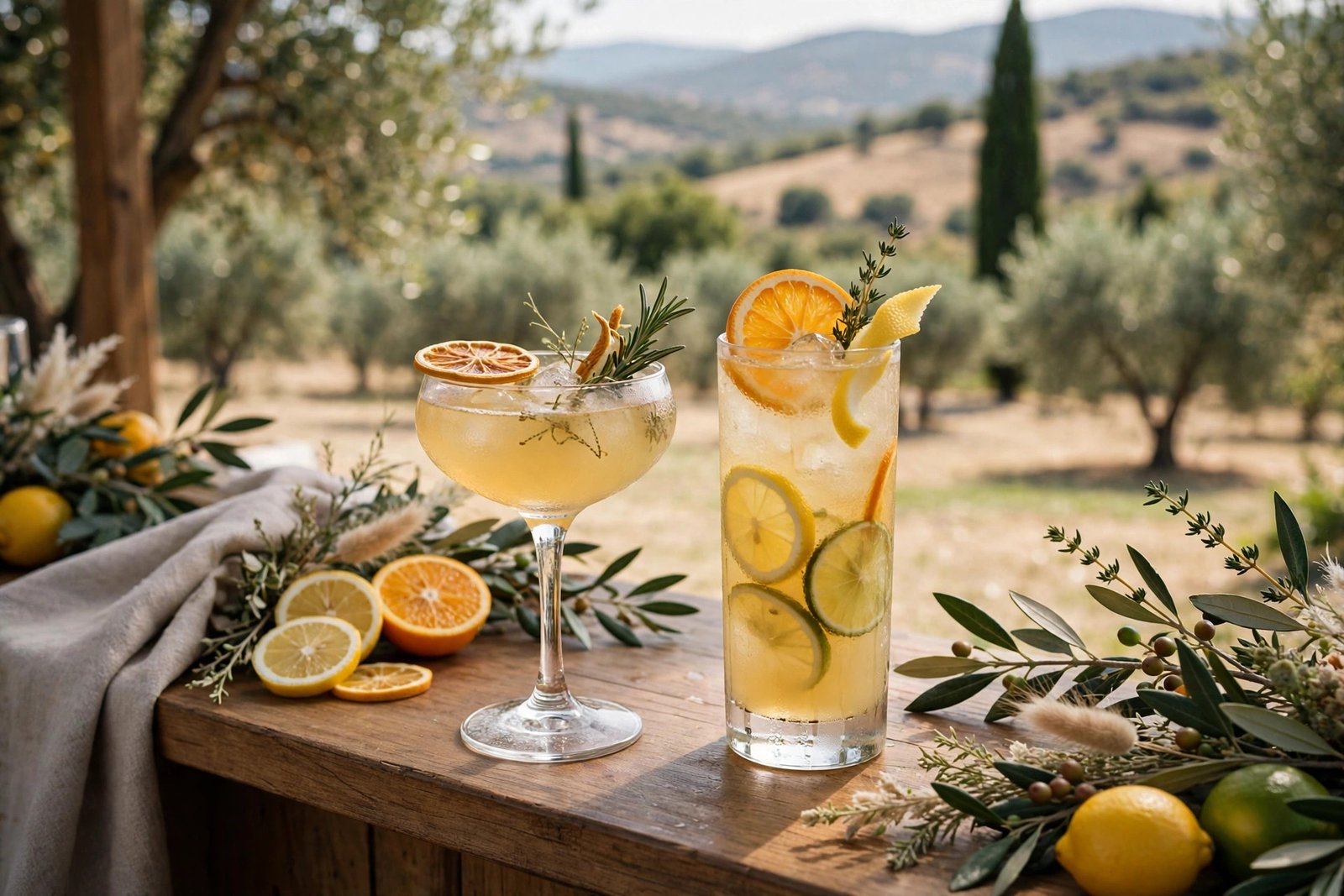
Split those 6 to 7 bottles across your two cocktails: 3 bottles of each covers 48 to 51 drinks per cocktail. Keep the base spirits simple. A vodka cocktail and a bourbon or tequila cocktail cover the two crowds, and both use the same mixers already on the table: club soda, tonic, cranberry juice, and citrus. Your caterer can confirm the pour size before the tasting, since a 2-ounce pour instead of 1.5 ounces cuts each bottle from 16 drinks to 12.
Wedding Alcohol Quantity Chart (50, 100, 150 & 200 Guests)
Here is what the numbers look like in actual bottles and cases for a standard 4-hour reception under the 50/30/20 full bar split.
| Guest Count | Total Drinks | Wine Bottles (750ml) | Beer Cases (24 pack) | Liquor Bottles (750ml) | Estimated Cost |
|---|---|---|---|---|---|
| 50 Guests | 250 servings | 25 bottles (~2 cases) | 3 cases (72 beers) | 3-4 bottles (750ml) | $550 – $850 |
| 100 Guests | 500 servings | 50 bottles (~4 cases) | 6 cases (144 beers) | 6-7 bottles (750ml) | $1,100 – $1,750 |
| 150 Guests | 750 servings | 75 bottles (~6 cases) | 9-10 cases (216-240 beers) | 10-11 bottles (750ml) | $1,700 – $2,600 |
| 200 Guests | 1,000 servings | 100 bottles (~8 cases) | 13 cases (312 beers) | 13-15 bottles (750ml) | $2,200 – $3,400 |
Note: A standard 750ml wine bottle yields 5 five-ounce glasses. A standard 750ml liquor bottle yields roughly 16 to 17 1.5-ounce pours.
What Does the Bar Cost Per Guest? $11 to $17.50
Divide each row’s cost range by its guest count and the numbers line up: the bar costs about the same per guest at any size.
| Guests | Total Alcohol Cost | Cost Per Guest |
|---|---|---|
| 50 | $550 to $850 | $11 to $17 |
| 100 | $1,100 to $1,750 | $11 to $17.50 |
| 150 | $1,700 to $2,600 | $11.33 to $17.33 |
| 200 | $2,200 to $3,400 | $11 to $17 |
That flat per-guest cost is why the guest count, not the drink menu, drives the bar budget. Cutting 25 guests saves roughly $275 to $437 in alcohol alone at $11 to $17.50 per guest. The per-guest cost holds whatever dinner format you pick, since the chart counts alcohol only. Stack the other savings on top: $1,200 to $2,800 by buying your own alcohol instead of a venue package, and $250 by skipping full champagne pours. Add the $125 to $175 single-day liability policy from the FAQ below, and a 100-guest bar lands at $1,225 to $1,925 all in. Check the full budget picture in our wedding budget guide before you lock the bar number.
The Champagne Toast Trap (Why Couples Waste Hundreds)
The traditional champagne toast is one of the biggest budget wasters in wedding catering. Many couples buy one full flute per person. What actually happens is that servers pour 120 flutes, guests take one ceremonial sip for the speech, and staff throw out 90 half-full glasses of warm sparkling wine.
Skip the full pours. Plan on half a glass (3 ounces) per guest for toasts, which yields 8 servings per 750ml bottle instead of 5. For 100 guests, you need only 12 to 13 bottles (roughly 1 case) of Prosecco or Cava rather than 20 bottles. Better yet, let guests toast with whatever drink they already have in hand–nobody notices, and you pocket an extra $250.
How Much Ice, Mixers, and Garnishes Do You Need?
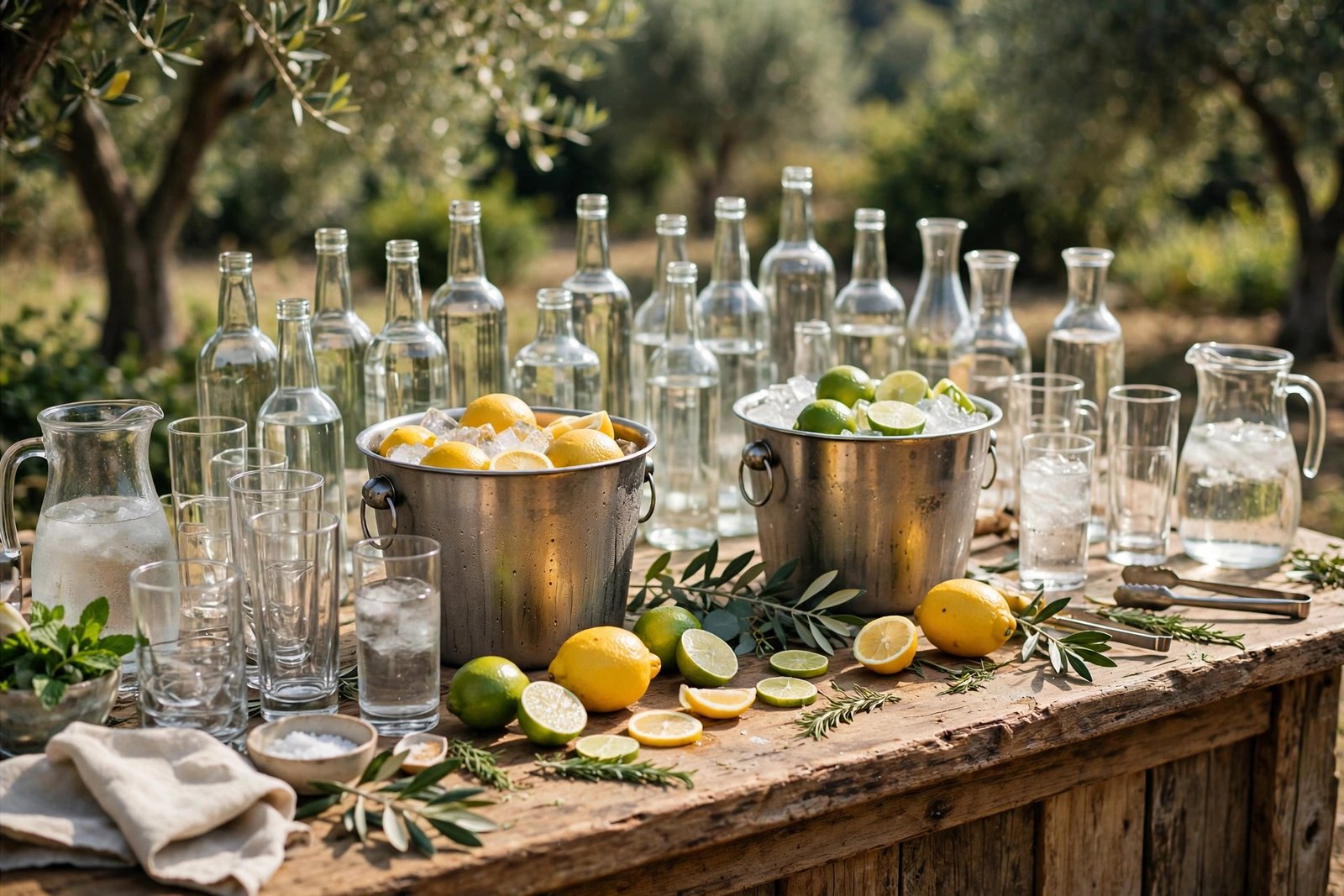
Couples remember the vodka and forget the tonic. Running out of ice will shut down your bar faster than running out of gin.
| Bar Essential | Amount per 100 Guests (4 Hours) | Practical Purchasing Tip |
|---|---|---|
| Ice | 150 – 200 lbs (1.5-2 lbs/guest) | Buy in 20-lb bags. Store in insulated coolers behind bar. |
| Club Soda / Seltzer | 12 – 15 liters | Cans stay fizzy longer than 2-liter bottles behind a fast bar. |
| Tonic Water | 8 – 10 liters | Buy standard cases of 12-oz cans. |
| Cranberry / Citrus Juices | 4 – 6 gallons total | Keep refrigerated until poured into speed pourers. |
| Lemons & Limes | 25 lemons, 40 limes | Pre-slice before the ceremony to save bartender time. |
| Simple Syrup & Bitters | 2 bottles syrup, 1 Angostura | Prep batch simple syrup 48 hours in advance. |
Buy in the right order and the ice never melts before the first dance. Wine, beer, and liquor go in the cart weeks ahead: unopened cases are returnable in California, Texas, Illinois, and New York. Mixers, garnishes, and syrup go in the week of the wedding, and the simple syrup gets prepped 48 hours ahead so it is cold when the bar opens. Ice is the last purchase, on the wedding day itself, in 20-lb bags straight into insulated coolers behind the bar. A 100-guest wedding needs 150 to 200 lbs, which is 8 to 10 bags. Pre-slice the 25 lemons and 40 limes before the ceremony so the bartender pours instead of cutting.
Return Policies: Can You Return Unopened Cases?
Before purchasing your haul, check your state alcohol laws. In states like California, Texas, Illinois, and New York, retailers are legally permitted to accept returns on unopened, undamaged cases of wine and liquor. Stores like Total Wine & More and BevMo routinely accept unopened cases with a valid receipt.
Costco allows alcohol returns in some states but forbids them in others based on local municipal beverage control boards. Always ask the store manager about their return policy before loading your cart, and keep all original case cardboard intact.
What stays behind after the last dance still has value. Unopened cases go back to the store where the state allows it, and opened bottles go home with the couple. Ask the venue where leftover cases should be staged before the reception ends, and put the return trip on the day-after checklist while the receipt is still in the same bag as the packing list.
Frequently Asked Questions
Hover or tap any question below to reveal the answer.
What is the cheapest way to provide alcohol at a wedding?
You avoid 25% catering markups, 22% venue service fees, and per-head package pricing.
Should we do an open bar or a cash bar?
If budget is tight, offer a modified open bar featuring two signature cocktails, two beers, and two wines rather than a full top-shelf liquor setup.
How many bartenders do we need for 100 guests?
If lines exceed 4 people, your bar will bottleneck and cut into dancing time.
Do we need liability insurance if we supply our own alcohol?
Almost all venues require a Certificate of Insurance (COI) with Host Liquor Liability naming the venue as additionally insured. A single-day event insurance policy through providers like WedSafe or Wedsure costs between $125 and $175.
How much alcohol do I need for 50 guests?
Double it for 100 guests: 500 servings, 50 wine bottles, 6 beer cases, 6 to 7 liquor bottles, at $1,100 to $1,750.
How far in advance should I buy wedding alcohol?
Buy mixers and garnishes in the wedding week, prep simple syrup 48 hours ahead, and buy ice on the wedding day.