

A friend just asked you to officiate their wedding. Say yes, then get the legal part right first: in most US states you can get ordained online for free in about 10 minutes, but the county where the ceremony happens decides whether that ordination counts, and you are the person who must return the signed marriage license on time. This guide covers all 6 steps in order, from ordination to a filed license, in about 9 hours of work spread over 2 to 3 months. Start with the ceremony order so you know what each part of the service must include.
Editorial Note: This guide was researched and written by our small editorial team under the pen name Claire Sterling. We are researchers and writers, not a wedding planning agency. Prices are typical national ranges, not quotes — confirm locally before you buy.
Before You Start: 6 Things to Confirm First

Confirm these 6 things before you say yes: the date, time, and place; the state and county; whether the couple wants a religious or secular ceremony; the guest count; whether you must register with the county; and who files the license. If any one of these is unclear, ask the couple before you accept, not after.
- Date, time, and place. You need the exact venue address, because the county where the ceremony happens sets the rules, not the county where you live or where the couple lives.
- State and county. Marriage law is set at the state and county level. The rules that apply in one county may not apply in the next one.
- Religious or secular. A secular ceremony follows the standard arc in Step 3. A religious ceremony follows the rules of that faith, and the couple should confirm them with their own clergy.
- Guest count. A 20-minute ceremony works for 20 guests and for 200 guests, but the rehearsal and the microphone setup change with the size of the room.
- Registration. Some counties require ordained ministers to register before the ceremony. Ask the clerk; do not assume.
- Who files the license. In most cases that person is you. The couple obtains the blank license, and you return the signed one.
Say the couple asks you 6 months before a 100-guest wedding with a 20-minute ceremony at a local venue, and you are doing it as a friend for free. Here is the full run, start to finish:
| When | What you do | Time |
|---|---|---|
| 6 months out | Say yes, get ordained, call the county clerk | 1 hour |
| 3 months out | Meeting 1 with the couple: story, tone, readings | 30 minutes |
| 2 months out | Meeting 2: vows, rings, rituals, music cues | 30 minutes |
| 1 month out | Write the full script | 3 hours |
| 2 weeks out | Meeting 3: read-through (20 minutes), then format and print the script (30 minutes) | 50 minutes |
| 1 week out | Rehearsal at the venue with the wedding party | 2 hours |
| Wedding day | Ceremony, then sign the license with the couple and 2 witnesses | 1 hour |
| Day after | File the license with the clerk | 15 minutes |
| Total | About 9 hours |
Step 1: Get Ordained Online in 10 Minutes, or Hire a Pro for $200 to $800
Most first-time officiants get ordained free online in about 10 minutes. A hired professional costs $200 to $800, and most couples land between $300 and $500.
| Route | Typical cost | What it covers | Best for |
|---|---|---|---|
| Friend ordained online | $0 to $60 | Ordination is free; optional printed credentials cost $20 to $60 | A friend or family member, in most states |
| Professional celebrant | $200 to $800 | Consultation, custom script, rehearsal, license filing | A personal ceremony with no legal hassle |
| Religious officiant | $50 to $300 | Suggested donation to the house of worship | A faith-based ceremony |
| Justice of the peace | $25 to $150 | Legal ceremony only, little personalization | A courthouse wedding or elopement |
| Premium metro celebrant | $600 to $1,200+ | Fully custom ceremony in a major city | High-demand cities like New York or Los Angeles |
| Marriage license fee | $20 to $115 | Paid by the couple to the county | Every wedding |
Two points matter more than the price. First, ordination alone is not enough in every county: some require you to register, and a few do not accept online ordination at all. Step 2 covers that. Second, the couple pays the license fee, not you. If the couple hires a professional instead, treat the officiant like any other vendor and use the wedding vendor checklist to compare quotes, contracts, and cancellation terms.
Step 2: Confirm the County Rules 60 Days Before the Wedding
Call the county clerk where the ceremony happens, not where you live, at least 60 days before the wedding. Ask these 4 questions, and write the answers down.
- Do you accept online ordination? Most counties do. A few do not.
- Must I register with your office before the ceremony? Some counties require ordained ministers to register, and some want a letter of good standing.
- What documents do you need from me? Common answers: an ordination certificate, a letter of good standing, or a photo ID.
- What is the deadline for returning the signed license? Most states give you 3 to 30 days. New York gives you 5 days.
Start this call 60 days out because registration can take 30 or more days, and some offices work by appointment only. If the clerk says online ordination is not accepted, do not argue the point. New York courts have voided marriages performed by online-ordained ministers, so the safer route there is a one-day marriage officiant license: any adult 18 or older can apply to the same clerk’s office that issued the couple’s license, after the couple has the license and before the ceremony.
Step 3: Interview the Couple and Write the Script in 3 Meetings
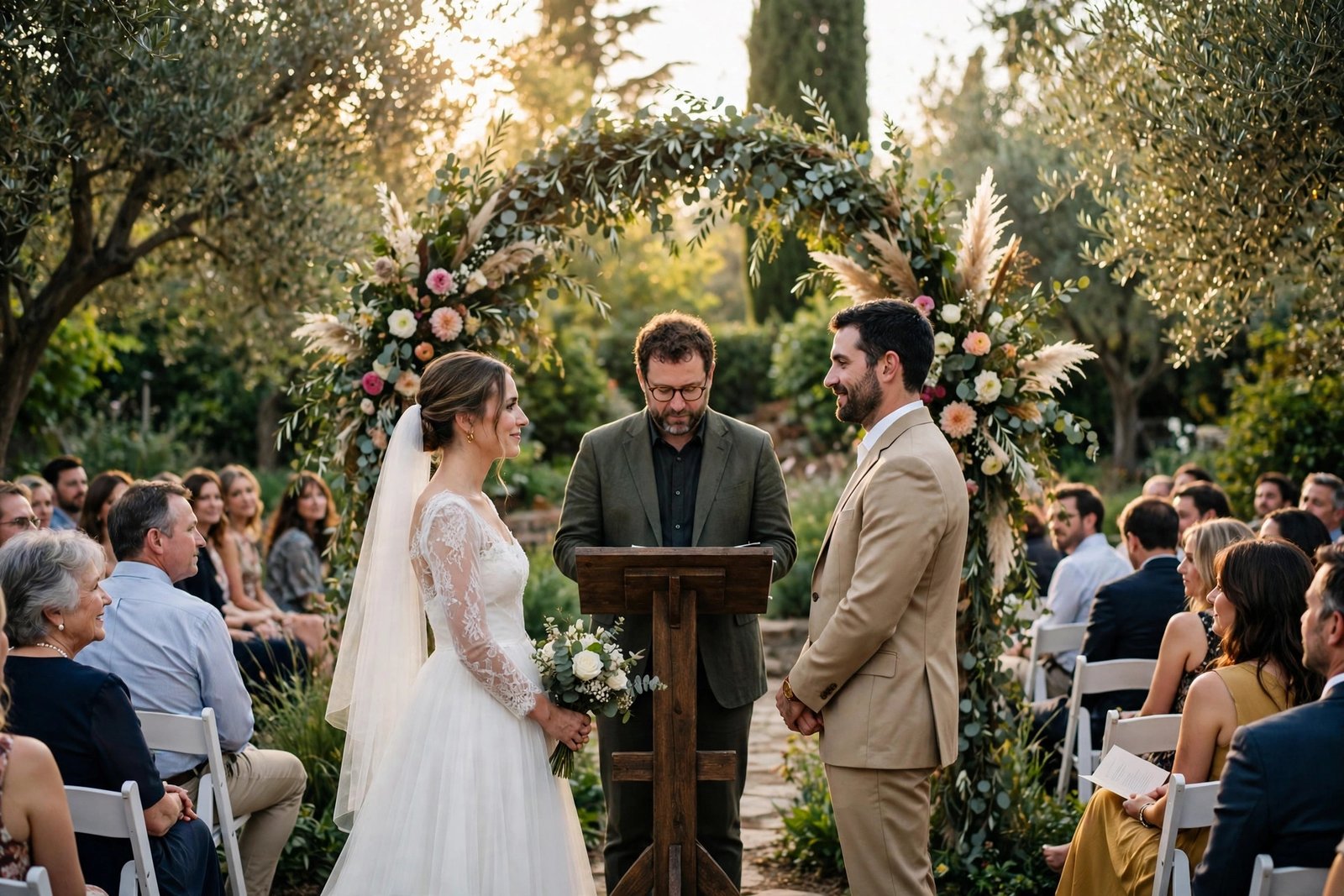
Three short meetings give you everything the script needs: the story, the tone, and the exact words for the legal parts.
Meeting 1, 30 minutes, 3 months out. How they met, what matters to them, and the tone: formal, light, religious, or secular. Ask for 2 or 3 stories you can use, and ask what they do not want mentioned.
Meeting 2, 30 minutes, 2 months out. Readings, vows, ring exchange, any unity ritual, music cues, and who stands where. Confirm who reads what, and confirm the exact names and pronunciations.
Meeting 3, 20 minutes, 2 weeks out. Read the full script out loud together. Fix anything that sounds stiff, cut anything that runs long, and confirm the legal lines word for word.
The ceremony follows a standard arc. Two lines in it are legal requirements, not decoration: the declaration of intent and the pronouncement must both be spoken.
| Part | Minutes | Legal or optional |
|---|---|---|
| Welcome and opening | 1 | Optional |
| The couple’s story | 3 to 4 | Optional |
| Readings | 2 | Optional |
| Declaration of intent | 1 | LEGAL — must be spoken |
| Vows | 3 | Optional wording, required exchange |
| Ring exchange | 2 | Optional wording |
| Pronouncement | 1 | LEGAL — must be spoken |
| First kiss and recessional | 2 | Optional |
| Total | 15 to 20 |
Write for the ear, not the page. Use short sentences, active verbs, and one idea per line. Read the script out loud while you write it: if a sentence trips you up, cut it in half. Match the script to the wedding processional order so your opening line lands the second the couple reaches you.
Step 4: Format the Script So You Never Lose Your Place
Print the script in 14-point type with one section per page, stage cues in bold capitals, and a backup copy in someone else’s hands. A script you cannot read at a glance is a script you will stumble over.
Put page numbers on every page. Write names phonetically if they are hard to pronounce. Mark your pauses with [PAUSE] and your moves with cues like [HAND OVER RINGS] and [STEP ASIDE]. Keep water and a pen on the lectern. Never read from a phone: screens lock, glare hits at the wrong moment, and notifications appear at the worst possible second.
Print 2 copies. Keep one yourself and give the other to the best man or maid of honor. If your copy blows away or gets rained on, the ceremony continues without a pause.
Step 5: Rehearse Out Loud 2 Times Before Wedding Day
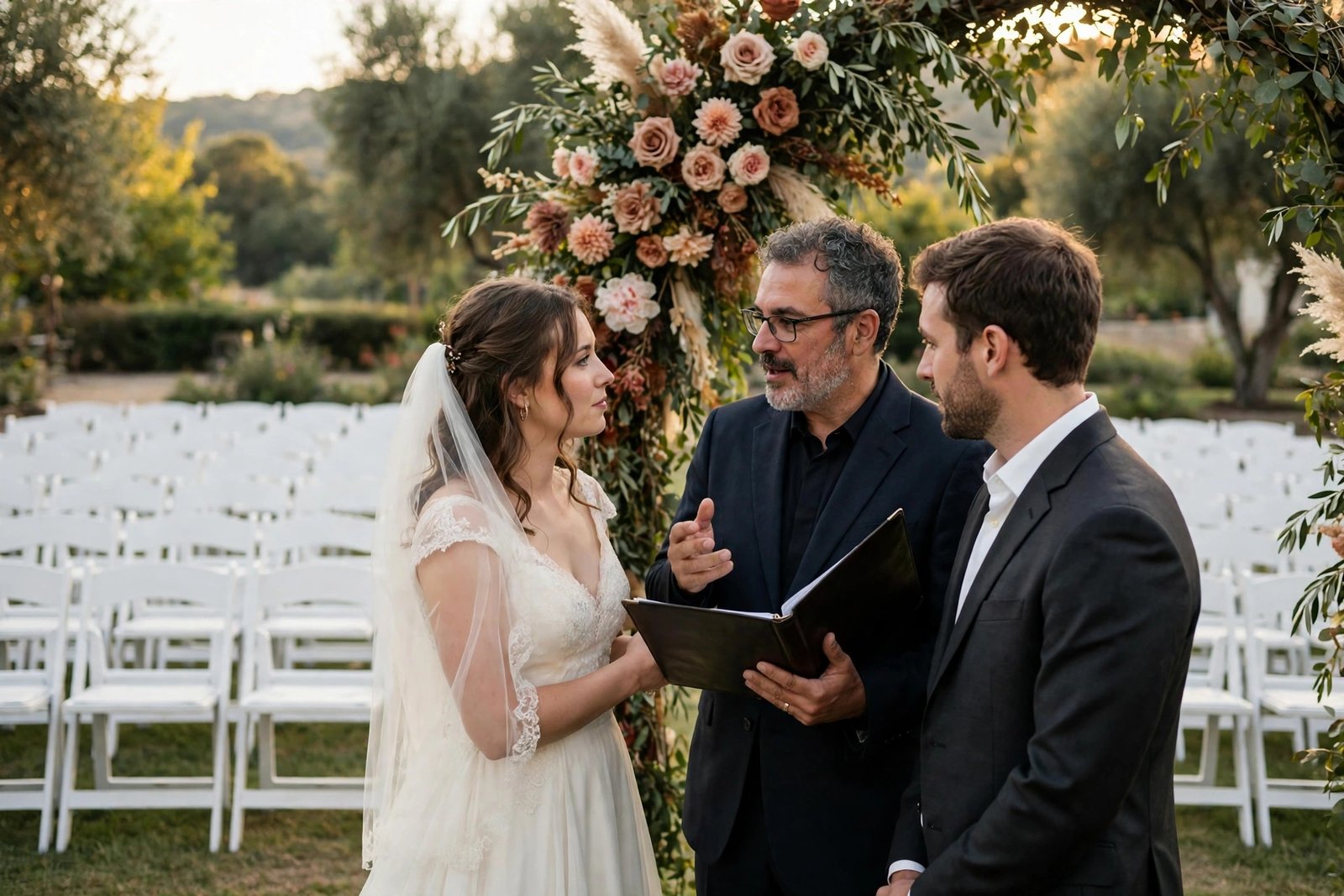
Rehearse twice: once alone with a timer, once with the couple and the wedding party at the venue. A script that reads well on paper can still run 10 minutes long out loud.
Alone, 1 week out, 30 minutes. Read the full script standing up, at full volume, with a timer running. Aim for 15 to 20 minutes. Cut anything that pushes you past 20.
At the venue, 1 to 2 days before, 1 hour. Walk the processional, mark positions, test the microphone, practice the ring handoff, and confirm who holds the license and the pen. End the rehearsal by walking the recessional, so everyone knows where to go when the ceremony ends.
Bring the printed script, a pen that works, water, and your phone on silent. The couple brings the license. Slot the rehearsal into the wedding day timeline template so the wedding party knows exactly when to show up.
Step 6: Complete and File the License Within 5 Days
Sign the license with the couple and 2 witnesses right after the ceremony, check every field before you leave the venue, and return it to the clerk within the deadline: 3 to 30 days in most states, 5 days in New York. This is the one step that cannot be fixed with a good speech.
Check these fields before anyone leaves: names spelled exactly as on IDs, the date, the place, your signature and title, both witness signatures, and any ordination details the clerk asked for. One wrong letter can send the license back.
Mail it the next business day by tracked mail if the clerk accepts it; some counties want it delivered in person. Keep a photocopy. The copy is not a legal document, but it proves you filed on time if the clerk misplaces the original. If the couple hired you, the usual thank-you is $50 to $100 — see the wedding tipping guide for who else gets an envelope.
When Online Ordination Is Not Enough: 4 Legal Routes Compared
If the county does not accept online ordination, or you are short on time, pick one of 4 routes instead of hoping the paperwork sorts itself out. The right route depends on the county rules and the time left, not on preference.
| Route | When it fits | Time needed | Typical cost |
|---|---|---|---|
| Online ordination | Most states, no registration required | 10 minutes | $0 to $60 |
| Online ordination + county registration | Counties that require registration | 30+ days before the wedding | $0 to $60 plus any county fee |
| One-day designation | New York, Massachusetts | Apply after the couple has the license | Varies by county |
| Hired professional | Any state, short notice, or a complex ceremony | Book 3 to 6 months out | $200 to $800 |
If you are under 2 weeks out and the county wants registration, hire a professional. The fee is $200 to $800, and the professional already holds the credentials the county accepts.
Common Mistakes and Fixes: 5 Errors That Cost Couples Real Money
Every mistake below has a fix that costs little or nothing. The expensive part is finding out after the wedding.
| Mistake | What it costs | The fix |
|---|---|---|
| License filed late | The marriage is not recorded on time, which delays name changes and benefits | Mail it the next business day; set a phone reminder for the morning after |
| Wrong signature or missing witness | The clerk rejects the license; you pay a re-issue fee of $20 to $115 and make a second trip | Check every field at the venue before anyone leaves |
| Officiant never registered | The ceremony may not count legally; the couple needs a second legal ceremony at the courthouse for $25 to $150 | Call the clerk 60 days out and ask the 4 questions in Step 2 |
| Script runs 35 minutes | Guests lose focus, photos run late, and every vendor after you waits | Time the rehearsal and cut the story to 3 to 4 minutes |
| No backup script | Lost pages or a dead microphone stall the ceremony | Print 2 copies; keep one with the best man or maid of honor |
Time and Cost Budget: 9 Hours of Work and $0 to $800
A friend officiant spends about 9 hours and $0 to $60. A hired professional costs $200 to $800, and the couple spends about 2 hours in meetings. The money table is in Step 1; this section covers the time.
| Task | Time | Who |
|---|---|---|
| Get ordained | 10 minutes | You |
| Call the county clerk | 30 minutes | You |
| 3 meetings with the couple | 1 hour 20 minutes | You + couple |
| Write the script | 3 hours | You |
| Format and print | 30 minutes | You |
| Rehearsal | 2 hours | You + wedding party |
| Ceremony and license signing | 1 hour | You + couple + 2 witnesses |
| File the license | 15 minutes | You |
| Total | About 9 hours |
The script is the biggest block at 3 hours. If the couple hires a professional, that 3 hours becomes the professional’s job, and the couple’s time drops to the 3 meetings plus the rehearsal.
Frequently Asked Questions
Hover or tap any question below to reveal the answer.
Can anyone officiate a wedding in the United States?
You need legal authority, which usually means online ordination, and you must meet the county rules where the ceremony happens. A few states and counties require registration or a one-day designation. Check with the clerk 60 days out.
How long does it take to get ordained online?
Ordination through the major online ministries is free and instant. Printed credentials and a letter of good standing take a few days to arrive by mail, so order them early if your county wants them.
Who signs the marriage license?
Check every name and date before you leave the venue. You are the person who returns it to the clerk.
How soon must the license be filed?
New York gives you 5 days. Mail it the next business day so the deadline never becomes a problem.
What should the officiant wear?
Match the formality of the wedding party: a suit or a formal dress for a formal wedding, smart casual for a garden ceremony. Avoid white, and avoid anything that pulls focus in photos.
Can a friend officiate a wedding in New York?
The safer route is a one-day marriage officiant license from the clerk who issued the couple’s license. Apply after the couple has the license and before the ceremony.